
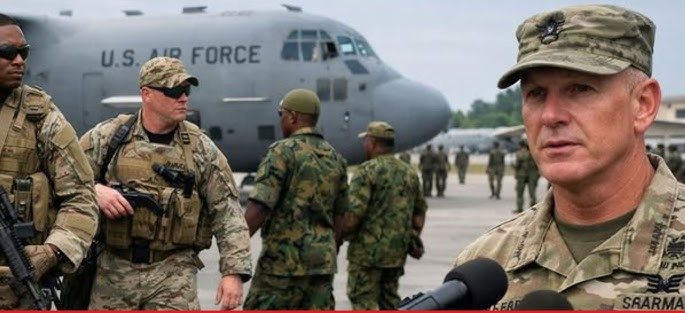
The United States has announced plans to withdraw about 200 troops deployed to Nigeria earlier this year to support the fight against Islamist militants, as its counterterrorism mission in the country winds down.
According to a report by The New York Times, citing US military officials, the withdrawal is expected to be completed by late September.
However, the departure of the larger contingent will not end US security cooperation with Nigeria, as smaller teams of military trainers and intelligence analysts are expected to remain in the country.
The US troops were deployed to northeastern Nigeria in February following an agreement between Washington and Abuja to strengthen cooperation against terrorist groups operating in the region.
The deployment focused on intelligence support, training and counterterrorism operations rather than establishing a permanent US combat presence in Nigeria.
US and Nigerian officials have described the relatively small deployment as highly effective, particularly in improving intelligence sharing and supporting operations against Islamic State militants.
The mission reached a major milestone in May, when US and Nigerian forces conducted an operation that killed Abu Bilal al-Minuki, described by US officials as a senior Islamic State leader operating in the Lake Chad Basin.
US officials said the operation significantly weakened the group’s leadership structure in Nigeria and the wider region.
The Nigerian deployment has subsequently been described by US officials as a potential model for future American security operations in Africa, based on a smaller and temporary military footprint focused on specific objectives.
Despite the reported gains, however, terrorist attacks and other forms of insecurity have continued across Nigeria.
In recent days, gunmen have carried out deadly attacks in parts of the country, while a major assault was also launched against a military base in northeastern Nigeria.
Nigeria’s broader security challenges include attacks by Boko Haram and Islamic State West Africa Province (ISWAP), as well as banditry, kidnappings, communal violence and other forms of armed conflict.
The Nigerian government has repeatedly maintained that the country’s insecurity is complex and driven by multiple factors rather than a single cause.
The US withdrawal is therefore not expected to end military cooperation between Washington and Abuja. Instead, intelligence sharing, training and other forms of security assistance are expected to continue through the smaller US teams that remain in Nigeria.
The planned drawdown represents a shift from a larger temporary deployment towards a more limited support role, with Nigerian forces expected to retain the lead in counterterrorism operations within the country.


