Delcy Rodriguez sought investment and debt support in New York while facing pressure to set a timetable for elections…..
Venezuela’s interim president, Delcy Rodriguez, arrived in New York with an ambitious message for investors: the once-sanctioned oil producer was ready to reopen its economy and attract international capital.
She left the United States days later without any major business agreements publicly announced, despite holding talks around debt restructuring, energy and mining and making a high-profile appearance alongside US President Donald Trump.
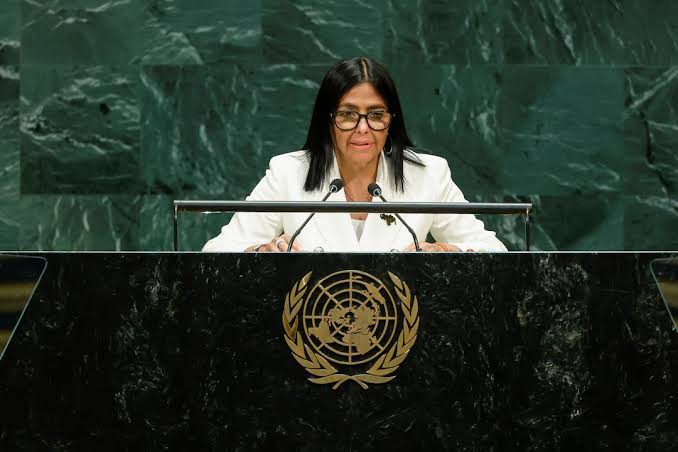
Rodriguez used her address to the United Nations General Assembly to promise that Venezuela would hold elections as part of a transition towards what she described as “full democracy”.
Her visit was her first to the United States since American forces captured former Venezuelan President Nicolas Maduro during a January raid.
For analysts, the trip offered a striking picture of the relationship between Washington and Venezuela’s new administration: Rodriguez emerged as an important interlocutor for Caracas, but the US retained considerable influence over the direction of the transition.
“Rodriguez enjoyed a week of high visibility. Yet, when we make a list of concrete results, the outcome is modest. Where are the disbursements, the reconstruction package or the business deals? They did not materialize on the scale that would have allowed New York to be portrayed as Venezuela’s great financial comeback,” said Washington-based analyst Antonio De La Cruz.
Trump signals US influence
The extent of Washington’s leverage was underscored during Trump’s address to the UN General Assembly.
“To the victor belong the spoils,” Trump told the assembly, while Rodriguez listened, adding that the United States remained prepared to deploy its “unmatched military might”.
Trump did not refer to Rodriguez by name in the speech, and there was no official readout of his brief meeting with her.
The encounter nevertheless became one of the most visible moments of her visit, with photographs of the two leaders circulating as Caracas sought to project a new relationship with Washington.
De La Cruz said the meetings demonstrated that Washington was helping shape Venezuela’s emerging political landscape, while Rodriguez had established herself as the principal channel of communication with the United States.
But he said that position also carried a growing political burden.
“She will have to explain when Venezuelans will actually vote,” he said.
Election timetable comes under scrutiny
Rodriguez had spent months avoiding a firm commitment on when elections would take place, while US officials had cautioned that a vote would require time to organise.
That position is now facing greater scrutiny.
Analysts and Venezuelan opposition parties say pressure is building for the interim government to establish a timetable, while experts have estimated that organising a credible election could take at least 12 months, including the appointment of trusted electoral authorities.
The White House and Venezuela’s information and foreign affairs ministries did not respond to requests for comment on the election timetable or the substance of bilateral discussions.
US Secretary of State Marco Rubio said after Rodriguez’s meeting with Trump that the two discussed restructuring Venezuela’s sovereign debt and that Washington had pressed for political change.
“For this project to be successful, it culminates in a free and fair election,” Rubio said.
Investment talks produce few public results
Expectations had been high before the Venezuelan delegation arrived in New York.
Officials were expected to engage US authorities, international lenders, allied governments and companies in the energy and mining sectors, with sources suggesting that preliminary agreements could emerge from the meetings.
By Saturday, however, no major agreements had been publicly announced.
The Inter-American Development Bank said it was working towards approval of a $2.5 billion bridge loan for Venezuela, although Reuters reported that some members of the bank’s board were opposed to the proposal.
The absence of announced deals left questions over whether Rodriguez’s highly visible diplomatic push had translated into immediate economic commitments.
Old alliances show signs of strain
Rodriguez also found herself navigating a changing international environment.
Cuba, once one of Maduro’s closest allies, walked out of the UN chamber when Trump turned his attention to the country during his speech. Rodriguez remained in the hall as Trump referred to Maduro as an “outlaw dictator”.
Sources said officials from Caracas and Havana largely avoided one another during the gathering.
A Russian delegation, meanwhile, sought talks with Venezuela’s Foreign Minister Felix Plasencia over Moscow’s interests in Venezuelan oil projects, according to a source cited by Reuters.
The discussions come amid reports that ExxonMobil has been negotiating a possible return to the Petromonagas oil development, in which Russia’s state-owned Roszarubezhneft has an interest.
Russian officials did not immediately respond to requests for comment.
Brazilian President Luiz Inacio Lula da Silva also weighed in on the political transition, telling CNN that Washington appeared to treat Rodriguez as though it were her superior and saying he would call elections if he were in her position.
Opposition pressure follows Rodriguez to New York
Rodriguez’s visit was accompanied by protests from Venezuelans living in the United States.
More than 50 demonstrators gathered outside the UN, carrying signs including “New Face, Same Regime” and calling for Rodriguez to join Maduro in the Brooklyn jail where he is awaiting trial.
The opposition movement also remained a factor during the visit. Media reports said opposition leader Maria Corina Machado, who could potentially seek office in a future election, was again prevented from returning to Venezuela from Panama.
For Rodriguez, the New York visit therefore delivered considerable international visibility and opened discussions on Venezuela’s debt and economic future, but the absence of major announced deals leaves the interim government with a more immediate question: how and when will its promise of a return to elected government be put into practice.