The Federal Government has unveiled plans to reposition Nigeria’s education and skills system to produce trained, certified and adaptable workers capable of competing in the global outsourcing and digitally enabled services market.
Minister of Education, Dr. Maruf Tunji Alausa, disclosed this at the Hire From Nigeria side event on the margins of the 81st United Nations General Assembly in New York.
According to Ikharo Attah, Special Adviser (Media and Communications) in a Statement on 27th September, 2026, Alausa said the Federal Ministry of Education was serving as the supply engine of the National Talent Export Programme, which targets the creation of one million export-linked jobs and 10 million globally certified Nigerians by 2030.
He said Nigeria’s youthful population, English-language advantage, cultural adaptability and growing digital capabilities offered the country significant opportunities in the global outsourcing economy.
“Nigeria’s greatest asset is its people: a young, ambitious, English-speaking and increasingly digitally capable population. Our task in Education is to turn that scale into verified competence and reliable service delivery,” he said.
The minister identified the mismatch between training and changing employer demands, limited work-based learning opportunities and inadequate access to internationally recognised certification as key challenges facing the sector.
He said the government was addressing the gaps through curriculum reform, stronger accreditation and quality assurance, as well as expanded digital and technical training through federal institutions and accredited private providers.
Alausa called for greater involvement of employers in the education and training process, saying the country needed “a permanent employer-led feedback loop, not occasional curriculum reviews.”
He urged employers to participate in programme design, training, assessment, certification and recruitment, while also providing feedback on workforce performance.
The minister disclosed that the Federal Government’s free Technical and Vocational Education and Training (TVET) programme had attracted more than one million applications, with 160,000 trainees supported through about 1,200 centres nationwide.
He said the government was also promoting multiple pathways to employment and enterprise through university education, TVET, apprenticeships and continuous upskilling.
On the impact of artificial intelligence, Alausa said Nigeria must prepare young people to work alongside emerging technologies rather than compete with them on routine tasks.
“We must train young people to work with artificial intelligence, not to compete with it on routine tasks,” he said.
He listed skills such as judgement, creativity, domain knowledge, data literacy, cybersecurity, cloud services, software development, customer success, quality assurance and AI-enabled operations as increasingly important in the changing labour market.
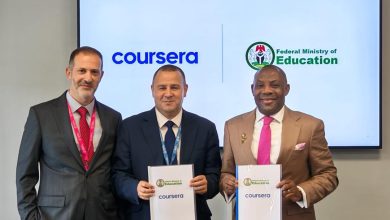
Alausa also disclosed that the Federal Government’s Digital Training Academy was partnering with global learning platforms, including Coursera and Pluralsight, to provide 32,000 Nigerians with free access to professional digital and technology training.
According to him, the programme covers areas including cloud computing, cybersecurity, artificial intelligence and machine learning, fintech, automation, product management, quantum computing and natural language processing.
He further said the Student Venture Capital Grant was supporting students in STEMM disciplines to transform innovative ideas into viable businesses.
The minister called on international employers, Business Process Outsourcing operators, investors and development partners to move beyond expressions of interest and establish practical partnerships that would create sustainable talent pipelines.
He urged BPO operators and investors to expand delivery centres beyond Nigeria’s major commercial cities while supporting training infrastructure, connectivity, quality systems and management capacity.
Alausa said development partners could also support the initiative through internationally recognised certification, instructor development, labour-market intelligence, inclusion of women and underserved communities, and systems for measuring employment outcomes.
He said the Ministry would deepen industry participation in curriculum development and certification, expand market-relevant TVET and digital skills programmes, strengthen accreditation and quality assurance, and improve links between institutions, training providers and employers.
The minister said these measures were part of the Ministry’s responsibilities under the National Talent Export Programme, where it leads the Supply Technical Working Group.
He reaffirmed the Ministry’s commitment to aligning education reforms with President Bola Ahmed Tinubu’s Renewed Hope Agenda, particularly in the areas of human capital development, job creation, skills acquisition and inclusive economic growth.