
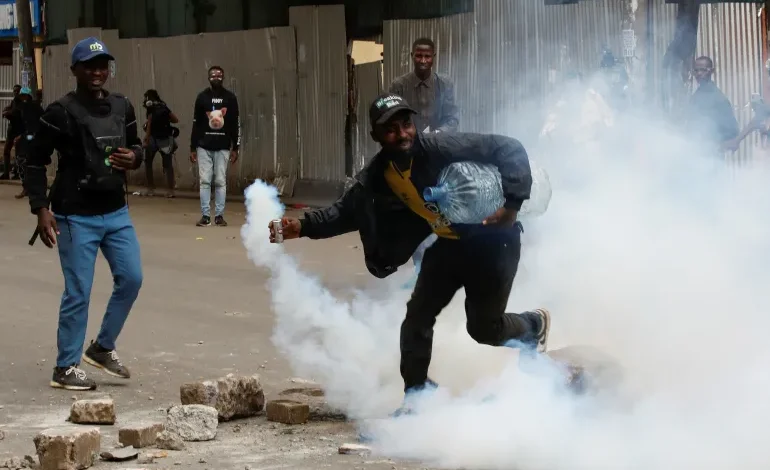
Tear gas filled parts of Nairobi’s central business district on Friday as police moved to disperse traders protesting new customs valuation rules they fear could drive up the cost of imported goods and push small businesses further into financial distress.
The confrontation brought fresh tension to the heart of Kenya’s commercial capital, with traders shutting their shops and taking to the streets in opposition to the Kenya Revenue Authority’s latest customs measures.
Businesses across parts of the CBD remained closed as traders demonstrated against the new valuation benchmark, which came into force on August 20. Police fired tear gas as protesters moved towards the KRA headquarters at Times Tower, according to a Reuters witness.
The dispute centres on the KRA’s decision to increase the minimum customs benchmark for a consolidated 40-foot container from KSh2.5 million to KSh3.2 million — an increase of about 28%.
For thousands of small-scale importers who rely on consolidated shipments to reduce transportation and logistics costs, the increase has become a major source of concern.
Traders say the higher benchmark could translate into increased customs payments and squeeze profit margins in businesses already grappling with rising operating costs.
But the tax authority says the measure is not designed to impose an arbitrary tax on every imported container. Instead, KRA says the benchmark is intended to curb the under-declaration and undervaluation of goods, practices it argues have allowed some importers to pay less customs duty than they should.
The authority has also clarified that KSh3.2 million is a minimum reference value, not a fixed valuation for every container. Importers whose goods are worth more than the benchmark are expected to declare their actual value and pay the corresponding customs duties.
That explanation has done little to calm traders, who fear that the new system will ultimately increase the cost of bringing goods into Kenya.
The protests disrupted commercial activity along several major streets in Nairobi’s CBD, including Tom Mboya Street, Moi Avenue and Luthuli Avenue, as traders closed their premises and joined the demonstrations.
For many of them, the dispute is about more than customs paperwork. They say higher import costs could threaten the viability of small businesses that depend on affordable access to overseas goods and operate on relatively narrow margins.
The demonstrations also underscore the delicate balance facing the Kenyan government as it seeks to increase tax revenues and clamp down on customs fraud without placing additional pressure on the country’s small-business sector.
KRA maintains that stronger valuation controls are necessary to protect government revenue, support compliant businesses and safeguard local manufacturers from unfair competition.
Traders, however, want the government to reconsider the new benchmark and engage with them over what they describe as the potentially damaging consequences for small enterprises.
With shops closed and police deployed to contain the demonstrations, Nairobi’s CBD became the latest flashpoint in a wider debate over taxation, the rising cost of doing business and the economic pressures facing Kenya’s traders.


