Former President Olusegun Obasanjo has warned that corruption remains a major obstacle to Nigeria’s development, saying its consequences fall most heavily on the country’s poorest citizens.
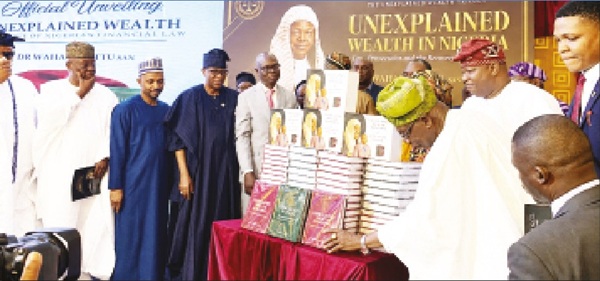
Obasanjo spoke in Lagos on Monday while chairing the public presentation of Unexplained Wealth: A Trilogy of Nigerian Financial Law, a three-volume work authored by Senior Advocate of Nigeria, Dr Wahab Shittu.
The former president called for stronger institutions and effective accountability mechanisms to ensure that public resources diverted through corrupt practices are recovered and those responsible are held to account.
He linked the issue of unexplained wealth to the wider challenge of corruption, arguing that illicit accumulation of resources undermines economic progress and weakens the ability of government to improve the lives of citizens.
Obasanjo also reflected on efforts made during his administration to strengthen Nigeria’s anti-corruption framework, including the establishment of the Independent Corrupt Practices and Other Related Offences Commission and the Economic and Financial Crimes Commission. He said stronger legal, investigative and asset-recovery mechanisms remained essential to confronting illicit wealth.
The event also featured the Emir of Kano, Muhammadu Sanusi II, who cautioned that legal reforms targeting unexplained wealth would have limited impact without corresponding political and judicial reforms.
Sanusi stressed the importance of ensuring that anti-corruption laws are enforced consistently and impartially, warning that political influence could undermine investigations and create unequal treatment in the application of the law.
Representing former Vice-President Yemi Osinbajo, his former Chief of Staff, Ade Ipaye, emphasised the need for a transparent and constitutionally sound framework for recovering assets suspected to have been stolen.
He said such a system must strike a balance between recovering illicit assets and protecting property that has been legitimately acquired.
The book reviewer, Professor Olanrewaju Fagbohun, SAN, similarly urged caution in the application of unexplained wealth laws, particularly given the scale of Nigeria’s informal economy.
Fagbohun argued that the absence of conventional financial documentation should not automatically be treated as evidence that wealth was illegally acquired. He said enforcement must balance the recovery of illicit assets with the protection of legitimate property rights.
For Shittu, the author of the trilogy, the central challenge is developing a credible legal and institutional framework capable of distinguishing legitimate wealth from illicit enrichment.
He stressed the importance of reliable financial records in determining the legitimacy of assets and transactions, warning that weak documentation and enforcement mechanisms could result in suspicion being treated as proof.
Shittu said wealth accumulation itself was not unlawful, but the means through which wealth is acquired remains critical in determining whether it is legitimate or illicit.
The discussions at the event therefore centred on strengthening Nigeria’s anti-corruption framework while ensuring due process, protection of legitimate property rights and consistent enforcement of the law.
The three-volume publication examines the legal, institutional and practical challenges surrounding unexplained wealth, prosecution and the recovery of illicit assets in Nigeria.