Minister of State for Industry, John Owan-Enoh, says small businesses remain central to Nigeria’s economic survival, accounting for 96 per cent of businesses nationwide, as the Federal Government moves to strengthen manufacturing and support local enterprises…..
Micro, Small and Medium Enterprises (MSMEs) contribute nearly half of Nigeria’s Gross Domestic Product (GDP) and account for the vast majority of employment opportunities, highlighting their importance to the country’s economic growth, Minister of State for Industry, Senator John Owan-Enoh, has said.
According to the minister, MSMEs represent 96 per cent of businesses operating across the country, contribute 48 per cent to GDP and provide 87 per cent of total employment.
Owan-Enoh made the disclosure on Sunday night in Calabar, Cross River State, during a town hall meeting with business operators organised by the Directorate of Manufacturing and MSME of the All Progressives Congress (APC) Presidential Campaign Council.
He described small businesses as the driving force behind Nigeria’s economy, arguing that their contributions to productivity, job creation and national development make them indispensable to the country’s economic progress.
Speaking at the gathering, the minister said the figures surrounding MSME participation in the economy should encourage policymakers to prioritise the sector and create an environment where businesses can grow and thrive.
He said, “If you look at the MSME ecosystem and appreciate the fact that about 96 per cent of businesses in our country are MSMEs, contributing about 48 per cent to our GDP and 87 per cent to employment, then you begin to wonder what else is left,”
“MSMEs are actually our economy. You all who are seated here are actually the economy of Cross River and Nigeria,” he added.
The minister explained that the meeting represented the first public engagement of the Directorate of Manufacturing and MSME ahead of the APC presidential campaign rally in Cross River State.
Owan-Enoh also praised the Cross River State Government, led by Governor Bassey Otu, for reviving the Micro-Enterprise Development Agency (MEDA), describing the move as an important intervention towards improving support for small businesses.
He noted that the state was working with several federal institutions to strengthen access to business development opportunities, financing and other forms of support for entrepreneurs.
Among the agencies involved are the Small and Medium Enterprises Development Agency of Nigeria (SMEDAN), Bank of Industry (BOI) and Nigerian Export-Import Bank (NEXIM).
The minister also highlighted several federal government projects and interventions in Cross River State, particularly those aimed at developing technical skills, supporting cleaner energy and encouraging industrial investment.
These include an automotive training centre at the University of Cross River, a Compressed Natural Gas (CNG) conversion workshop and a 65-kilowatt solar-powered electric vehicle charging station at the University of Calabar.
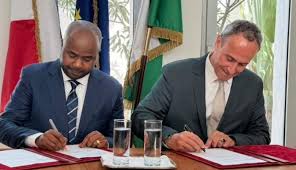
He further revealed that a Memorandum of Understanding (MoU) had been reached with a South Korean delegation towards establishing electric vehicle manufacturing operations in the state.
FG Introduces Measures To Expand Manufacturing And MSME Growth
The Federal Government has pursued several policy and financing initiatives aimed at strengthening Nigeria’s industrial sector, improving local production and helping small businesses transition into larger manufacturing operations.
In January 2026, the government introduced the Nigerian Industrialisation Policy, built around six strategic pillars, including MSME-to-industry transition, value-chain development and import substitution.
The policy targets increasing manufacturing’s contribution to Nigeria’s GDP to between 20 and 25 per cent by 2030.
More recently, the Bureau of Public Procurement (BPP) launched a free online training platform in October 2026 to help small businesses understand government procurement requirements and improve their chances of securing public contracts.
The Bank of Industry has also introduced financing interventions to support specific manufacturing value chains. In July 2026, the institution unveiled an €85 million financing facility aimed at expanding Nigeria’s cocoa processing industry, strengthening local value addition and reducing the country’s dependence on raw cocoa exports.
The interventions form part of broader efforts to improve the operating environment for Nigerian businesses, encourage domestic production and expand opportunities for small enterprises to contribute more significantly to economic development.