Embattled Spanish PM Sánchez Denies Foreknowledge of Massive Ceuta Migrant Influx

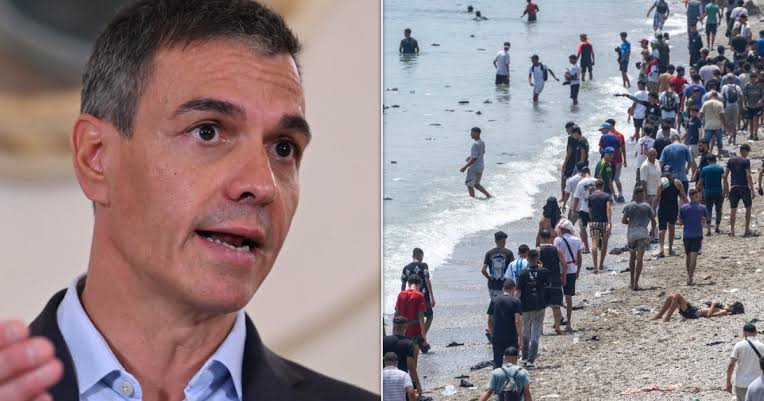
Spanish Prime Minister Pedro Sánchez has rejected claims that his government received advance warning of the unprecedented migrant surge into Ceuta, as mounting political pressure threatens to deepen the crisis.
Addressing parliament on Thursday, Sánchez maintained that the scale of the influx, which saw about 72,000 migrants enter the Spanish enclave from Morocco on July 30 and 31, could not have been predicted.
His defence comes as tens of thousands of protesters took to the streets across Spain, with opposition parties accusing the government of failing to act on warnings and mishandling the emergency.
The government has also faced renewed scrutiny over Morocco’s role. Sánchez continues to insist that there is no solid evidence that Rabat planned or carried out the mass crossing and has defended Spain’s close cooperation with Moroccan authorities in returning most of those who entered.
However, a Spanish police report submitted to the National Court has raised fresh questions. The document describes an unusually permissive response by Moroccan security forces and alleges that some officers may have actively directed migrants towards crossing points. The report stops short of establishing that the Moroccan government organised the operation.
Around 5,000 migrants are still believed to be in Ceuta, including roughly 1,200 children, after the vast majority were returned to Morocco or went back voluntarily.
The opposition Popular Party has intensified its attacks on Sánchez, accusing his administration of concealing information and demanding political accountability. The crisis has also generated tensions with European partners and added to growing public anger over the government’s handling of the situation.
What began as an extraordinary humanitarian and border emergency has now evolved into a major political crisis for Sánchez, with questions over intelligence warnings, Morocco’s conduct and the government’s preparedness continuing to dominate Spain’s political debate.