Government bond yields climb to multi-year highs across major economies as investors brace for further interest rate increases…..
A fresh wave of selling swept through global bond markets on Tuesday, driving government borrowing costs sharply higher and weighing on equities as escalating tensions in the Middle East revived fears of a new inflation shock and further interest rate hikes.
The latest confrontation between the United States and Iran has pushed oil prices higher, raising concerns that central banks may be forced to tighten monetary policy further at a time when global economic growth remains fragile.
The sell-off was particularly pronounced in major government debt markets.
In Britain, the yield on 30-year government bonds climbed to its highest level since 1998, while the benchmark 10-year yield rose to levels last seen during the global financial crisis of 2007 and 2008.
Japan also came under pressure, with its 10-year government bond yield hitting three per cent — a three-decade high — amid growing concerns over plans for large-scale government spending.
US Treasury yields moved higher as well. The yield on the 30-year bond stood at 5.27 per cent, close to levels last recorded in 2007, while the 10-year yield climbed to its highest point since January 2025.
Deutsche Bank analyst Jim Reid described the broad retreat from government debt as a global phenomenon, pointing to the renewed exchange of strikes between Washington and Tehran over the weekend as a major trigger.
The escalation has intensified concerns about energy supplies, particularly after oil prices rose by around two per cent on Tuesday. The conflict, now in its sixth month, remains unresolved, with Iran continuing to keep the strategic Strait of Hormuz closed while the United States maintains a counter-blockade of Iranian ports.
US President Donald Trump has also threatened tougher action against Tehran, heightening concerns that the conflict could further disrupt global oil supplies.
Susannah Streeter, chief investment strategist at Wealth Club, said renewed threats of action against Iran — including its key oil export hub at Kharg Island — had once again brought supply concerns to the forefront of the market.
The energy shock is already feeding into inflation expectations. New data released Tuesday showed eurozone inflation accelerated to a three-year high of 3.3 per cent in August, strengthening expectations that the European Central Bank will raise interest rates again when policymakers meet next week.
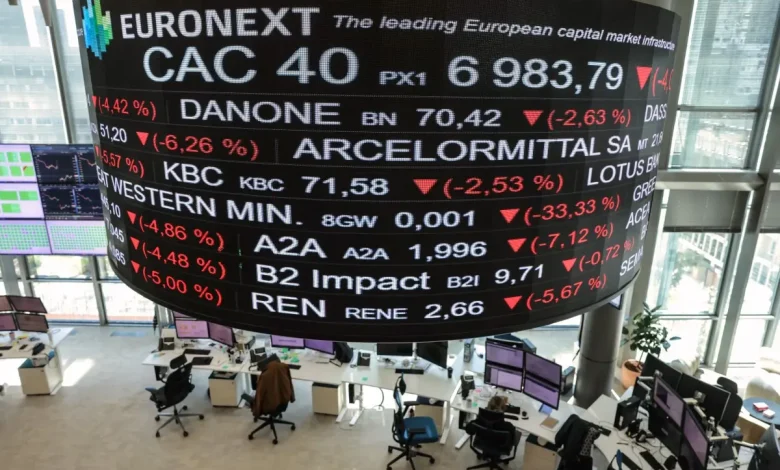
European equities reacted negatively, with Frankfurt falling by more than one per cent, while London also declined as trading resumed following a public holiday.
Investors are also looking ahead to crucial US economic data before the Federal Reserve’s September 16 policy meeting. Upcoming jobs and consumer inflation reports are expected to play a significant role in determining whether the central bank raises interest rates.
Expectations of another increase gained momentum after Federal Reserve Chair Kevin Warsh adopted a hawkish tone in a speech last Friday.
Asian markets had already closed lower, tracking losses on Wall Street. Tokyo, Hong Kong and Shanghai all finished in negative territory.
The Japanese yen also weakened against the dollar, despite US Treasury Secretary Scott Bessent saying he expected Japan to take steps to support its currency. The yen has surrendered roughly half the gains it made following a historic joint currency intervention after previously falling to a 40-year low.
Bessent’s comments were interpreted by markets as additional pressure on the Bank of Japan to tighten monetary policy when it meets later this month.
Fast-fashion giant Shein endured a volatile debut on the Hong Kong stock exchange, with its shares falling as much as 10 per cent after the company raised $1.7 billion in its long-awaited initial public offering. The stock later recovered most of those losses to finish almost unchanged.
Taiwanese chipmaker MediaTek, however, surged nearly 10 per cent after US technology giant Nvidia announced a $3.5 billion investment in the company.
By around 1110 GMT, Brent crude was up 1.8 per cent at $92.09 per barrel, while West Texas Intermediate gained 2.4 per cent to trade at $87.79.
In Europe, London’s FTSE 100 fell 0.8 per cent, Paris’ CAC 40 dropped 0.3 per cent, while Frankfurt’s DAX lost 1.1 per cent.
Earlier in Asia, Tokyo’s Nikkei 225 declined 0.2 per cent, Hong Kong’s Hang Seng Index fell 0.9 per cent, and Shanghai’s Composite Index slipped 0.2 per cent.
On Wall Street, the Dow Jones Industrial Average closed 0.7 per cent lower.
In currency trading, the dollar strengthened against the Japanese yen, while the euro and pound both weakened against the US currency.