Von der Leyen Proposes Closer EU-Canada Ties With New Membership Model

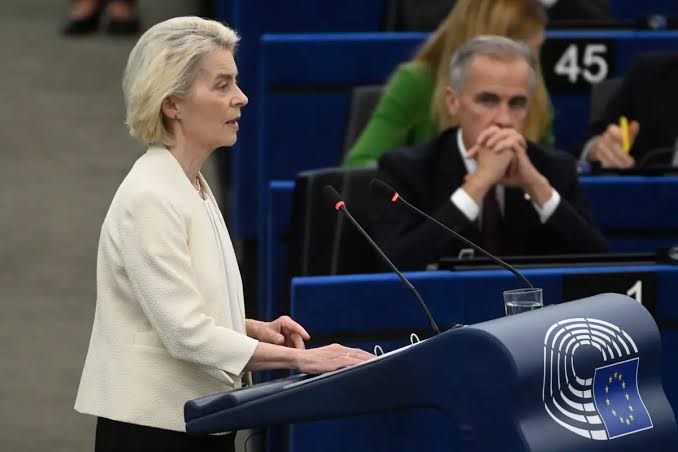
European Commission President Ursula von der Leyen has opened the door to an unprecedented new relationship between the European Union and Canada, proposing that Ottawa become the bloc’s first-ever “associate member.”
Speaking during her annual State of the European Union address in Strasbourg, von der Leyen said she wants to take EU-Canada relations to the “highest level possible” and build a new framework for closer economic and strategic cooperation. The proposed associate-member status does not currently exist under EU treaties.
Canadian Prime Minister Mark Carney was present in the European Parliament for the address and received a standing ovation from lawmakers. He is scheduled to address the European Parliament himself on Thursday, as Canada seeks to deepen its ties with Europe and diversify its economic partnerships.
Von der Leyen said the EU and Canada share common interests ranging from artificial intelligence and climate change to the Arctic, defence, critical raw materials and supply chains. She also pointed to their cooperation over Russia’s war in Ukraine and stressed that both sides remain committed to democratic values.
The proposal comes as Europe confronts what von der Leyen described as an increasingly hostile international environment, with Russia’s war in Ukraine, geopolitical tensions and hybrid attacks adding pressure on the continent.
She warned that Russian operatives were behind hybrid attacks on European soil, describing them as threats not only to individual EU member states but to the wider European Union.
For Canada, the proposed partnership could mark a significant expansion of its relationship with Europe, while for the EU, it represents a new model of cooperation with a major democratic partner outside the bloc.
The precise rights and obligations of any associate membership have yet to be defined, with further discussions expected ahead of the EU-Canada summit in October.