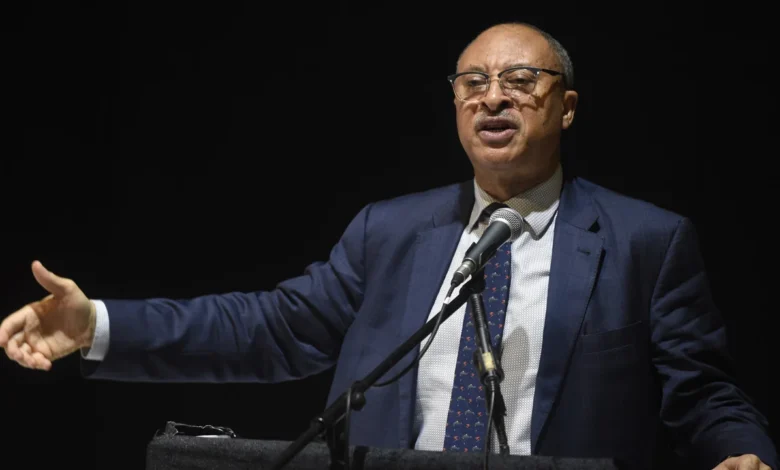
In a bold move aimed at redefining the political landscape in Nigeria, Professor Pat Utomi has officially unveiled members of his shadow cabinet under the “Big Tent” initiative — a reform-driven coalition designed to offer credible policy alternatives to the ruling establishment.
At the close of a two-day retreat in Abuja, Utomi, a renowned political economist and founder of the Centre for Values in Leadership, also endorsed the African Democratic Congress (ADC) as a viable political alternative to the dominant All Progressives Congress (APC) and People’s Democratic Party (PDP).
Utomi announced the appointment of key figures to his shadow cabinet, including:
Nana Kazaure – Minister for Information, Riwang Pam – Minister for Security, Nike Omola – Minister for Women and Gender Development, Peter Agada – Minister for Infrastructure, Urban Development, and Housing.
He emphasized that this initiative is not a political stunt or power grab, but a strategic response to the glaring gaps in governance and accountability in Nigeria.
“We are not competing with the APC; we are complementing democracy with a structure that offers evidence-based policy review. Our mission is to hold government accountable and drive national development from a place of expertise, not partisanship,” Utomi stated.
Utomi criticized the current state of governance where lawmakers routinely overstep their legislative mandate by executing constituency projects, blurring the line between executive and legislative responsibilities.
“In any functioning democracy, legislators are elected to make laws, not build boreholes. When they beg the executive for projects, they lose their autonomy and the checks and balances essential to good governance disappear,” he noted.
This, he argues, is part of a broader erosion of institutional roles, driven by lack of political education and absence of a unified national development strategy.
Utomi revealed that the concept of a shadow cabinet is not new in Nigeria’s political evolution. In fact, he proposed it to the late President Umaru Musa Yar’Adua in 2007 — a proposal Yar’Adua welcomed and even followed up with an invitation to join his government, which Utomi respectfully declined.
He pinpointed the real problem in Nigeria’s governance: not lack of resources or data, but lack of political will and discipline. Using the recently announced National Coastal Highway Project as an example, he argued that a proper development strategy would have involved consultations with states to align infrastructure with regional needs.
“There is no shortage of data or ideas. What Nigeria lacks is the will to act on them consistently and strategically.”
Taking aim at outdated agricultural policies, Utomi stressed that Nigeria must move beyond the “hoe-and-cutlass” mentality. Modern agriculture, he said, requires innovation, investment, and infrastructure — areas where current policies fall short.
He also reiterated the urgent need for state police, noting that without localized security, national stability will remain elusive.
On the adoption of the African Democratic Congress (ADC) as the flagship platform for the shadow cabinet coalition, Utomi called it a timely development.
“Nigerians are desperate for alternatives. The ADC coalition is still a work in progress, but it’s already creating a platform for issue-based politics driven by values and vision, not just party loyalty.”