Commodity traffic hits historic lows amid military tensions, vessel attacks, and competing US-Iran restrictions on strategic waterway….
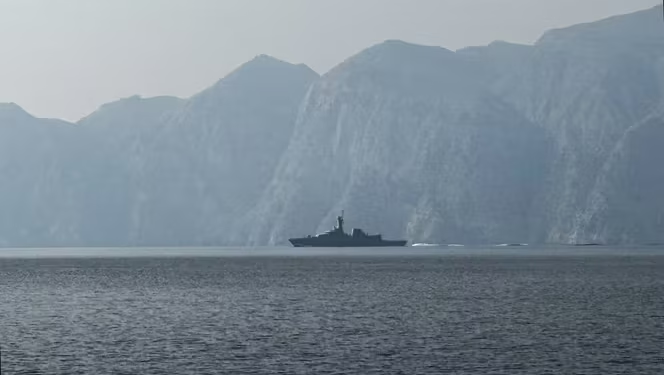
Commodity shipping through the Strait of Hormuz has fallen to its lowest level since the outbreak of the ongoing conflict, with data indicating an almost complete shutdown of commercial transit through one of the world’s most critical energy corridors.
According to marine analytics firm Kpler, only one commodity vessel passed through the strait on Monday, while no transits were recorded on Tuesday, a dramatic decline from normal activity levels.
In peacetime, roughly 120 vessels pass through the strait daily, according to maritime intelligence reports. The waterway typically handles about one-fifth of global hydrocarbon exports, making it one of the most strategically important maritime routes in the world.
The sharp drop in movement comes as tensions continue to escalate in the region following the outbreak of war triggered by US-Israeli strikes on Iran earlier this year.
Since then, maritime activity has been heavily disrupted by a combination of restrictions and retaliatory actions:
- Iran has tightened control over the strait, limiting vessel movement
- The United States has imposed countermeasures targeting Iranian port operations
- Security risks in surrounding waters have increased significantly
The result has been a near standstill in normal commercial shipping activity.
Minimal movement under tight conditions
The only recorded transit on Monday was the Nooh Gas, a vessel carrying 11,357 tons of Iranian liquefied petroleum gas. The cargo had been transferred via ship-to-ship operations near Dubai earlier in May, originating from Iran’s Bandar Mahshahr terminal. Its final destination has not been disclosed.
Maritime data shows that even when vessels do pass, routes and cargo movements are increasingly opaque due to heightened security risks and operational uncertainty.
The disruption also coincides with shifting military and diplomatic activity in the region.
US President Donald Trump recently suspended “Project Freedom,” a short-lived operation aimed at securing safe passage for merchant vessels through the strait.
Washington had claimed that two US-flagged ships successfully transited the waterway under the initiative, a statement strongly disputed by Tehran.
Rising attacks on shipping lanes
Even more concerning for maritime operators has been a spike in attacks targeting commercial vessels across the Gulf region.
Recent incidents include:
- Damage to the container ship San Antonio, operated by CMA CGM, with crew injuries reported
- Drone strikes on the tanker TMO Barakah, owned by UAE energy giant ADNOC
- An attack on the bulk carrier Minoan Falcon
The International Maritime Organization has confirmed multiple incidents since the weekend, noting an escalation in threats to both commercial shipping and regional stability.
A fragile global chokepoint
The Strait of Hormuz remains one of the most strategically sensitive maritime passages globally. Any prolonged disruption has immediate implications for global energy markets, shipping insurance costs, and supply chains.
With vessel traffic now reduced to a fraction of normal levels, the situation signals a deepening crisis at a chokepoint that underpins a significant share of global oil and gas trade.
For now, uncertainty dominates both over security conditions and whether diplomatic or military efforts will restore safe passage in the near term.