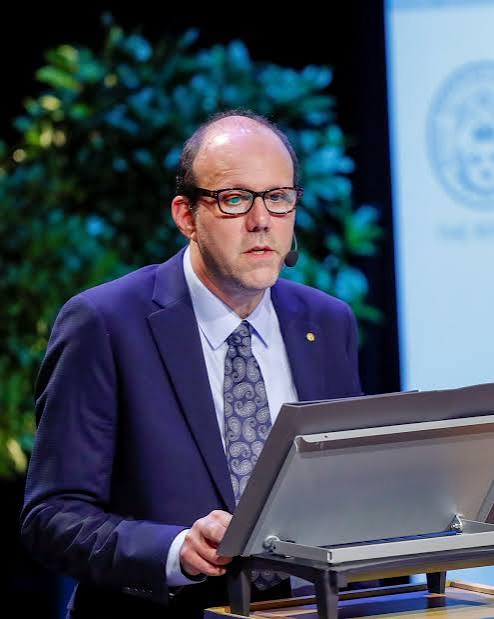
Kremer to lead research and development economics as World Bank steps up focus on jobs, private capital and evidence-based solutions….
Nobel Prize-winning economist Michael Kremer is set to become the World Bank Group’s next Chief Economist and Senior Vice President for Development Economics, taking charge of the institution’s research, data and analytical agenda.
World Bank Group President Ajay Banga announced the appointment on Wednesday, with Kremer expected to assume office on October 1, 2026.
The appointment brings one of the leading figures in development economics into the World Bank’s senior leadership at a time the institution is placing greater emphasis on evidence-based policies, job creation, private investment and development solutions that can be implemented at scale.
Kremer is recognised for applying rigorous economic research to practical development challenges, with his work influencing programmes covering areas such as vaccine access, school health initiatives and support for smallholder farmers.
Welcoming the appointment, Banga said the economist was joining the institution at a critical period for global development.
“I am pleased to welcome Michael to the World Bank Group. He joins us at a time when the world needs bold solutions to its most urgent development challenges, including creating jobs that meet the aspirations of more than 1.2 billion young people reaching working age in the coming decade,” Banga said.
He added that Kremer had spent his career establishing what works in development and demonstrating how such interventions can be taken to scale.
Kremer said the World Bank’s combination of research capacity and operational reach provided an opportunity to turn evidence into practical development outcomes.
“The World Bank Group has tremendous research capacity to develop and test innovative solutions to development problems—and the operational reach to scale them up and improve people’s lives,” he said.
He identified job creation, access to private capital, healthcare and education as some of the major challenges confronting developing economies, while noting that emerging technologies could also create new opportunities for growth.
Kremer said data, research and evidence would be critical in helping governments and businesses respond to those challenges while taking advantage of new technologies.
His appointment follows the departure of Indermit Gill, who served as World Bank Chief Economist and Senior Vice President for Development Economics for four years from September 2022 before leaving the institution in late August.
Kremer becomes the first economist to join the World Bank with a Nobel Prize already awarded to him. Former World Bank chief economists Joseph Stiglitz and Paul Romer received their Nobel Prizes after serving in the position.
The economist has previously used World Bank platforms to advocate reforms aimed at helping developing countries meet ambitious development targets.
In a 2024 speech at a World Bank event, Kremer called for greater support for innovative pilot programmes and incentives for research into emerging technologies, areas that have also featured prominently in Banga’s development agenda since he assumed the World Bank presidency in 2023.
The World Bank has increasingly sought to strengthen the link between its research and operations, with the institution aiming to use data and evidence to shape policies, investments, partnerships and scalable solutions across the public and private sectors.
Kremer brings extensive academic and research experience to the role.
He holds a PhD in Economics from Harvard University and is currently a University Professor at the University of Chicago, where he also serves as Director of the Development Innovation Lab.
His research has covered economic growth, technological change and development economics.
In 2019, Kremer shared the Nobel Prize in Economic Sciences with Abhijit Banerjee and Esther Duflo for their experimental approach to addressing global poverty.
Their work relied heavily on randomised controlled trials to test development interventions and establish evidence about which approaches produce measurable results.
Kremer is also a MacArthur Fellow, a member of the National Academy of Sciences, a Fellow of the American Academy of Arts and Sciences and a Presidential Faculty Fellow.
He co-founded the Bureau for Research and Economic Analysis of Development and is a Research Associate with the National Bureau of Economic Research.
Before moving to the University of Chicago, he served as the Gates Professor of Developing Societies in Harvard University’s Department of Economics.
Kremer will take up his World Bank position on October 1, 2026, succeeding Gill as the institution’s top economist and taking on a central role in shaping its research and development policy agenda.