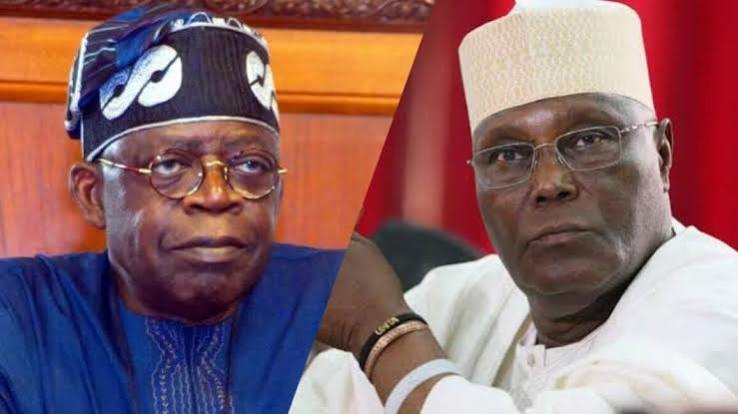
Former vice president asks Federal High Court to determine whether disputed document can bar President from next presidential election….
Former Vice President Atiku Abubakar has opened a fresh legal battle with President Bola Ahmed Tinubu, asking the Federal High Court in Abuja to determine whether an alleged discrepancy involving Tinubu’s National Youth Service Corps certificate should disqualify him from contesting the 2027 presidential election.
Atiku, who is the presidential candidate of the African Democratic Congress (ADC), personally appeared at the court registry on Friday to swear to an affidavit backing the suit filed against Tinubu, the All Progressives Congress and the Independent National Electoral Commission.
The case centres on an NYSC discharge certificate which Atiku alleges was submitted to INEC in Tinubu’s name but bears the name “Tinubu Bola Adekunle” rather than “Bola Ahmed Tinubu.”
Atiku and the ADC are asking the court to determine whether the disputed document amounts to a forged certificate within the meaning of the constitutional provision governing presidential eligibility.
The allegation remains a matter for judicial determination and has not been established against Tinubu by any court.
The suit relies on provisions of the 1999 Constitution, as amended, including Section 137(1)(j), as well as provisions of the Electoral Act 2026.
Atiku’s legal team is relying particularly on the constitutional provision dealing with the presentation of forged certificates to INEC.
The plaintiffs want the court to examine whether the disputed NYSC document was genuinely issued to Tinubu and whether the name appearing on it can legally be attributed to the President.
In his affidavit, Atiku alleges that the certificate was not obtained by Tinubu and was subsequently used in connection with his presidential candidacy.
He is also asking the court to compel INEC to produce Tinubu’s Form CF001 submitted for the 2023 and 2027 presidential elections.
According to Atiku, he previously sought certified copies of the relevant electoral records from INEC but did not receive them before filing the action.
Explaining why he personally went to the court registry to depose to the affidavit, Atiku said the issues raised in the case were too important to be left to political arguments.
He said the matter concerned constitutional standards and the integrity of the presidency and should therefore be settled through evidence before the judiciary.
Atiku also challenged the significance of the different names appearing on the disputed certificate, arguing that the court should determine whether the two names can properly be attributed to the same individual for the purposes of the document.
“If the certificate belongs to Bola Ahmed Tinubu, let that be established before the court,” Atiku said.
He insisted that Nigerians should not be required to settle the controversy through political debate or social media.
According to him, INEC is the institution holding the relevant records, while the judiciary has the responsibility to examine the evidence and determine the legal consequences.
The legal challenge goes beyond the disputed NYSC certificate.
Atiku and the ADC are also contesting provisions of the Electoral Act 2026 which they argue restrict the ability of candidates and political parties to challenge the qualification of presidential candidates before an election.
Their position is that ordinary legislation cannot override a constitutional provision dealing directly with eligibility for the presidency.
The plaintiffs have therefore asked the Federal High Court to determine whether the statutory restrictions can prevent them from invoking Section 137(1)(j) of the Constitution.
Atiku argued that the Constitution must remain supreme where a provision of an Act of the National Assembly is inconsistent with it.
Among the reliefs being sought by the plaintiffs is an order disqualifying Tinubu and the APC from participating in the 2027 presidential election if the allegations contained in the suit are established.
The case therefore places the President’s qualification and the electoral records held by INEC directly before the judiciary, adding another major legal dispute to an increasingly active 2027 political landscape.
Atiku maintained that occupying the presidency should not shield anyone from constitutional scrutiny.
“The presidency is not an immunity certificate against constitutional scrutiny,” he said.
He also urged INEC to demonstrate its neutrality by producing the records requested by the plaintiffs.
Counsel to the plaintiffs, Edwin Inegedu, SAN, and Joseph Onu Silas, expressed confidence in the case, saying their team had reviewed the relevant legal provisions and prepared its arguments.
Silas said the matter presented an opportunity for the courts to further clarify Nigeria’s electoral jurisprudence and pledged that the legal team would respond to the defendants’ arguments once they were served.
The suit now places three issues at the centre of the dispute: the authenticity and ownership of the disputed NYSC certificate, the electoral records in INEC’s custody, and the extent to which legislation can restrict constitutional challenges to a presidential candidate’s eligibility.
For Atiku, however, the broader issue is whether the same constitutional standards applied to other Nigerians should also apply to whoever seeks the nation’s highest elected office.
“Nobody is above the Constitution, not Atiku Abubakar, not Bola Tinubu, and certainly not the President of the Federal Republic of Nigeria,” he said.
INEC’s official electoral information currently lists the presidential and National Assembly elections for February 20, 2027.