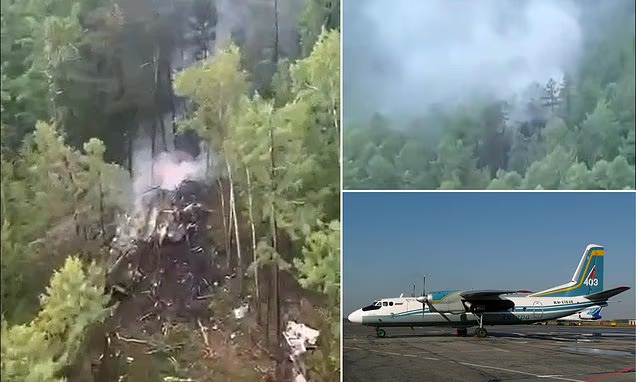
A regional passenger aircraft carrying nearly 50 people has crashed in Russia’s remote Far Eastern region of Amur, with no signs of survivors, officials said Thursday, in what marks one of the deadliest aviation incidents in the region in recent years.
The twin-propeller Antonov An-24, operated by Angara Airlines, disappeared from radar around 1:00 p.m. local time (0400 GMT) while en route from Blagoveshchensk to Tynda, a rugged and mountainous area near the Chinese border.
Hours later, a rescue helicopter located the wreckage in a densely forested area roughly 16 kilometers (10 miles) from its destination.
Russian investigators released video footage showing thick columns of smoke rising from the twisted fuselage, charred debris scattered across the forest floor.
“There are no signs of survivors,” local emergency officials told state-run media. The Amur Region Civil Defence Authority confirmed that a ground team had been dispatched to the crash site, but reaching the location is proving difficult due to the dense terrain and lack of access roads.
“At present, 25 personnel and five units of specialized equipment are en route, with four aircraft on standby for further operations,” the agency said.
Authorities have confirmed that the aircraft was carrying 43 passengers and six crew members, including five children, according to Amur Region Governor Vassily Orlov.
However, conflicting reports from Russia’s TASS news agency suggest the number of passengers may have been slightly lower.
Russia’s Far Eastern Transport Prosecutor’s Office stated that the plane crashed while attempting a second approach to Tynda Airport after aborting the initial landing attempt. Communications were lost shortly thereafter.
“The exact cause of the crash is still under investigation,” the prosecutor’s office said, adding that aviation specialists are working to determine whether weather, mechanical failure, or human error played a role.
The Antonov An-24, first introduced in 1959 during the Soviet era, is a rugged twin-propeller aircraft once widely used across Eastern Europe and Asia. Though production ceased decades ago, the aircraft remains in service in several remote regions of Russia.
According to TASS, the aircraft involved in Thursday’s crash was nearly 50 years old but had received an airworthiness extension through 2036.
This has reignited debate around Russia’s continued use of aging Soviet-era aircraft, especially in areas where newer jets are impractical due to harsh terrain or limited infrastructure.
Angara Airlines, a small regional carrier based in Irkutsk, has not yet issued a public statement regarding the crash.
Russia, especially in its vast and remote eastern territories, has long struggled with aviation safety. Despite modernization efforts, older aircraft remain the backbone of regional transport.
Harsh weather conditions, outdated navigation systems, and limited ground infrastructure often complicate flight operations in these areas.
Thursday’s crash underscores the persistent safety challenges in Russia’s aviation sector, even as the country pushes to phase out Soviet-built aircraft in favor of newer domestic models like the Sukhoi Superjet and the upcoming MC-21.
Rescue efforts are ongoing, and investigators from the Russian Federal Air Transport Agency (Rosaviatsiya) and Investigative Committee are expected to release preliminary findings in the coming days.