As over 3,700 participants compete in the National Girls in ICT programme, young innovators unveil solutions tackling agriculture, disability inclusion and emerging technology challenges…..
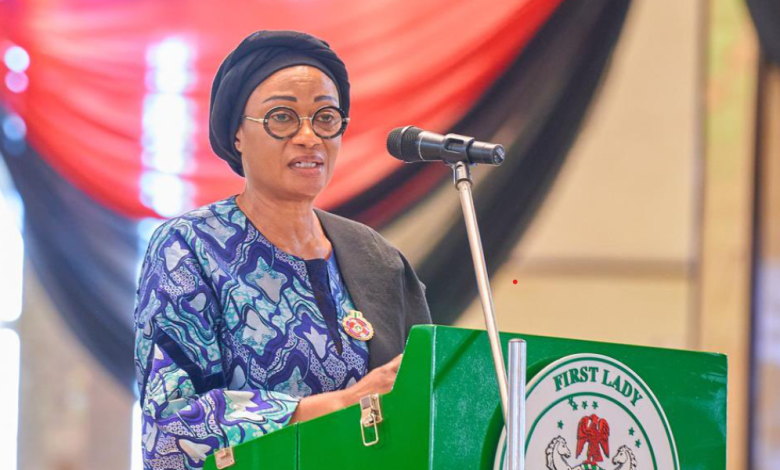
Nigeria’s First Lady, Senator Oluremi Tinubu, has called on young girls across the country to embrace technology and innovation, urging them to take an active role in building Nigeria’s digital future.
Speaking at the award dinner for the third edition of the National Girls in ICT Competition held at the State House in Abuja on Friday, the First Lady praised the creativity and determination displayed by participants, describing them as future leaders capable of transforming the country through technology.
The competition, organised by the Federal Ministry of Communications, Innovation and Digital Economy, drew more than 3,700 girls from the six geopolitical zones of the country. Participants took part in boot camps, mentorship programmes, innovation challenges and technology competitions designed to strengthen digital skills and problem-solving abilities.
Addressing the finalists, Tinubu encouraged them to remain bold in pursuing their ambitions.
“Remain curious, confident and courageous,” she said. “Never underestimate the power of your ideas. Your dreams are valid, your potential is limitless, and the future of innovation can proudly bear your imprint.”
She noted that the programme aligns with the Federal Government’s broader efforts to empower young Nigerians through education, technology and innovation under the Renewed Hope Agenda.
According to the First Lady, the quality of projects presented by participants demonstrates the enormous potential of Nigerian girls when provided with the right opportunities and support systems.
Among the innovations showcased were AI-powered solutions designed to protect farms from threats, smart fish pond monitoring systems, digital platforms supporting children with autism, and assistive technologies developed for deaf patients.
The standout project of the competition came from Special Education Centre, Bauchi, whose team emerged overall winner with “Hands That Speak,” a solution focused on improving communication and inclusion for individuals with hearing impairments.
Other top-performing schools included Federal Government Girls’ College, Cross River, which finished second, while Resonance Science School, Abia, secured third place. Sweet Heaven High School, Kano, Government Science Secondary School, Abuja, and Kidvarc High School, Osun, completed the top six rankings.
Winning teams received cash prizes, high-performance laptops and mentorship opportunities aimed at helping them further develop their innovations.
Earlier in the event, Minister of Communications, Innovation and Digital Economy, Bosun Tijani, stressed that Nigeria’s future competitiveness would depend more on human talent than natural resources.
He said the country is investing heavily in digital infrastructure, connectivity and technical education through initiatives such as Project BRIDGE, the Universal Service Provision Fund, the Three Million Technical Talent programme and the National Artificial Intelligence Strategy.
“Talent is everywhere in Nigeria, and opportunity must be provided everywhere too,” Tijani said, adding that empowering girls to participate fully in the digital economy is essential for national development.
The minister revealed that nearly two million Nigerians applied during the first week of the government’s technical skills training programme, underscoring the growing demand for technology-related opportunities across the country.
Minister of State for Education, Professor Suwaiba Sa’idu Ahmad, also commended the collaboration between the education and communications sectors, describing the initiative as a strategic investment in Nigeria’s human capital development.
Other speakers, including Postmaster-General Tola Odeyemi and NIGCOMSAT Managing Director Jane Egerton-Idehen, echoed the importance of nurturing talent from every part of the country regardless of background.
The National Girls in ICT Competition concluded after a week-long series of regional activities that brought together thousands of young girls to learn, collaborate and develop innovative solutions to real-world challenges.
For many of the participants, the programme was more than a competition, it was a glimpse into a future where Nigerian girls are not just consumers of technology, but creators of it.