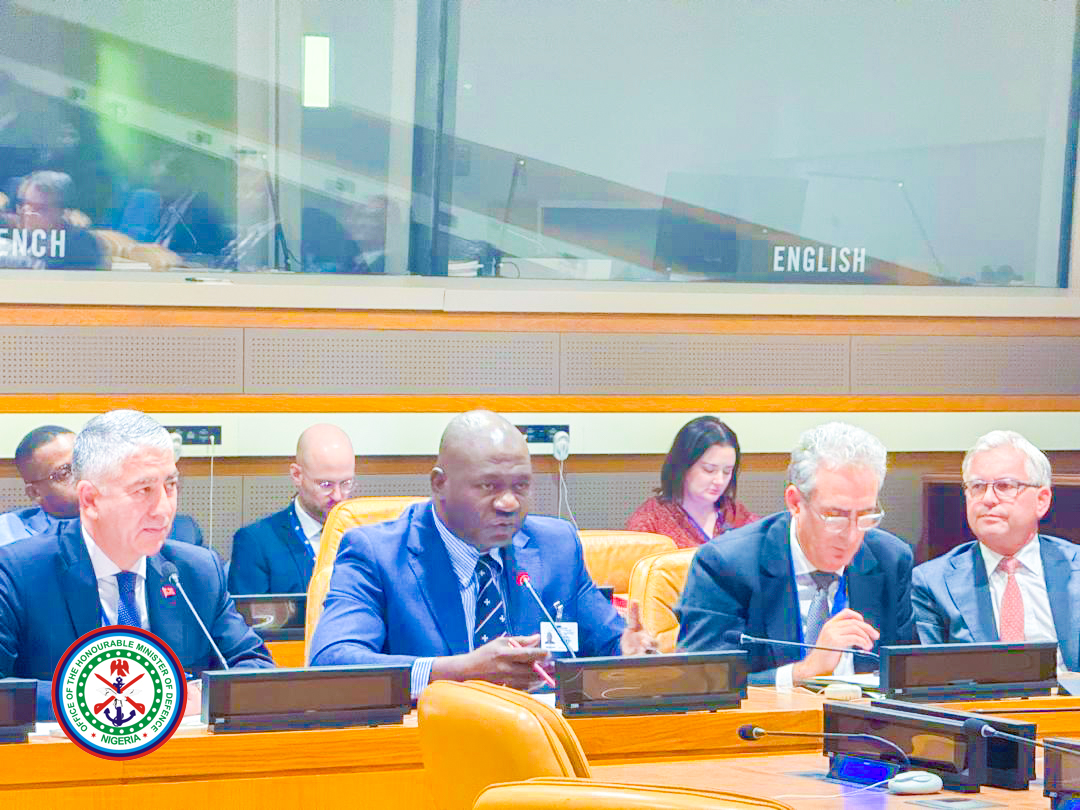
Nigeria’s Minister of Defence, General Christopher Gwabin Musa (rtd.), has called on the international community to move beyond short-term humanitarian interventions and establish sustainable support systems for victims and survivors of terrorism and violent extremism.
Leah Katung-Babatunde, SA (Media) to the Honourable Minister of Defence disclosed this in a Statement on Wednesday, September 23, 2026.
According to the Statement, Musa made the call at the Ministerial Meeting of the Group of Friends of Victims of Terrorism, held at the United Nations Headquarters in New York and co-convened by Spain and Iraq.
The Defence Minister said terrorism had continued to disproportionately affect Africa, noting that Sub-Saharan Africa accounted for about 60 per cent of global terrorism-related deaths in 2025.
He said the statistics represented families displaced, livelihoods destroyed, communities fractured and lives permanently altered by terrorism.
“Our task now is to ensure that the identified priorities and needs of victims, as well as lessons and good practices, are translated into sustained action,” Musa said.
Highlighting Nigeria’s counter-terrorism and justice efforts, the minister disclosed that the country had secured 865 terrorism-related convictions in 2026 alone.
He said the convictions demonstrated Nigeria’s commitment to accountability, adding that the government continued to prioritise the liberation of captives and comprehensive post-rescue support.
According to him, such support includes medical care, psychosocial rehabilitation, economic assistance and community reintegration.
Drawing from Nigeria’s experience in combating terrorism, Musa proposed a three-point framework for strengthening international cooperation: enhanced peer learning, inclusive partnerships and targeted United Nations support.
He advocated institutional mechanisms that would enable countries to share operational models, referral systems and lessons learned, including honest assessments of approaches that had failed to achieve their intended objectives.
Musa also called for stronger partnerships among national authorities, civil society organisations and victims’ associations, saying direct feedback channels would promote meaningful survivor participation in justice and rehabilitation processes.
He further urged the United Nations to expand technical assistance, capacity-building and resource mobilisation, particularly for countries carrying the heaviest burden of terrorism.
The minister commended United Nations initiatives, including the UNOCT Global Victims of Terrorism Support Programme and the Victims of Terrorism Associations Network (VoTAN), as well as Germany’s support for the development of the Toolkit for Technology-Enabled Support to Victims of Terrorism.
Musa reaffirmed Nigeria’s readiness to share its experience and expertise with other countries, expressing optimism about the International Conference on Victims of Terrorism scheduled to hold in Baghdad, Iraq, in the fourth quarter of 2026.