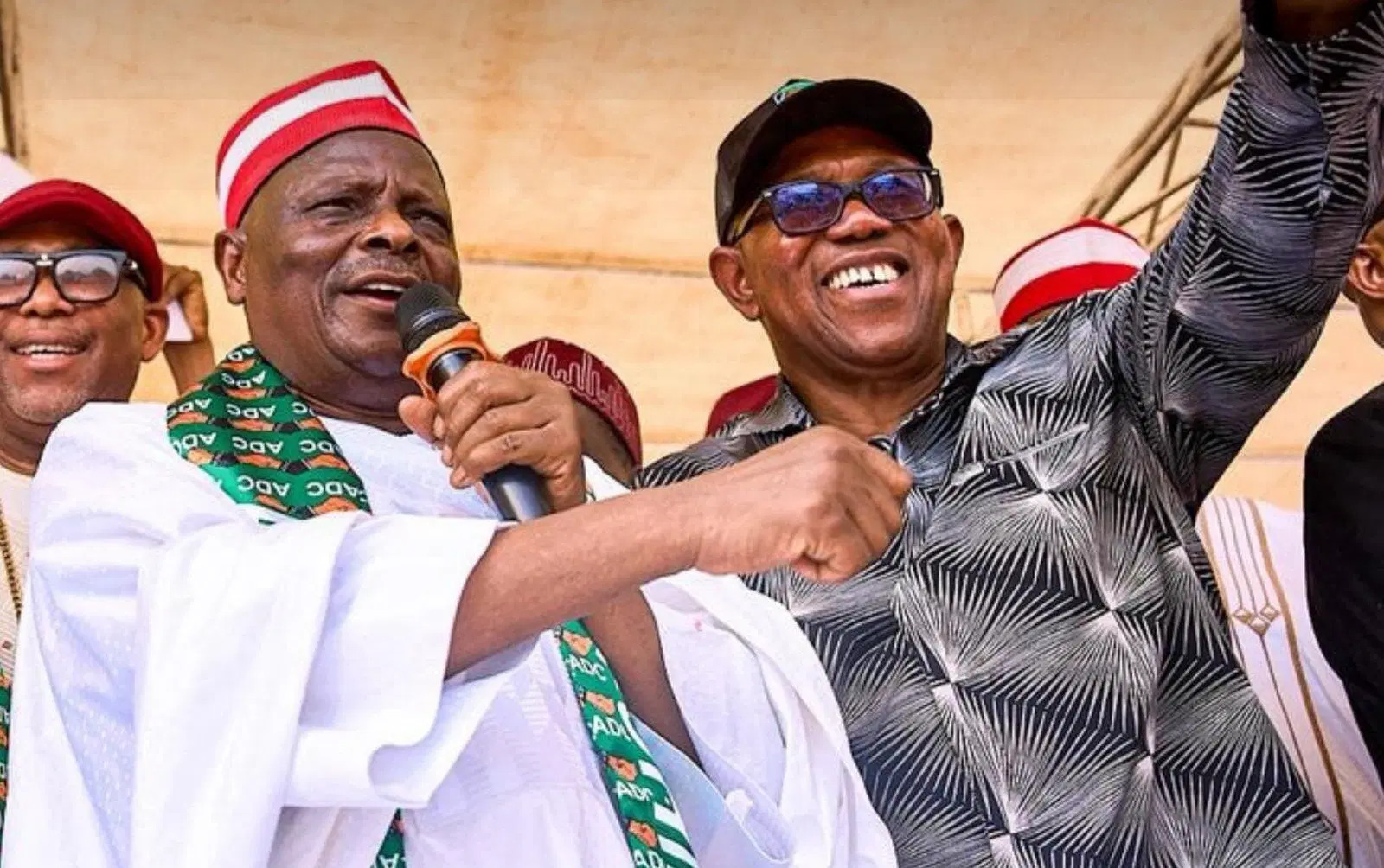
The Nigeria Democratic Congress (NDC) vice-presidential candidate, Rabiu Musa Kwankwaso, has ruled out withdrawing from the 2027 presidential election in favour of the African Democratic Congress (ADC) or any other party.
Kwankwaso, who is running alongside former Anambra State Governor Peter Obi, dismissed speculation about a possible last-minute alliance with the ADC, insisting that their joint ticket would remain in the race.
Reacting to recent exchanges between the opposition camps, the former Kano State governor criticised what he described as unnecessary attacks by the ADC Presidential Campaign Council on him, Obi and the NDC.
He urged opposition parties to focus on presenting their candidates’ records and policy proposals rather than engaging in disputes that could weaken efforts to challenge the ruling All Progressives Congress (APC).
“The attacks directed at me, our presidential candidate, His Excellency Peter Obi, and our party, the Nigeria Democratic Congress (NDC), are unnecessary and unhelpful,” Kwankwaso said.
He accused the ADC campaign council of diverting attention from its candidate’s credentials by questioning the NDC’s intentions and suggesting it could eventually withdraw in favour of the ADC presidential candidate.
“Rather than focusing on presenting the competence, credibility and capacity of their own candidate, as we have consistently done by placing our credentials and record of achievements before Nigerians, the ADC Presidential Campaign Council appears intent on creating mischief against our party and ticket,” he said.
Kwankwaso insisted that the NDC would neither support the APC nor surrender its presidential ticket to the ADC.
“Let me state clearly and unequivocally: we will not withdraw our candidature for the ADC or any other party. We remain confident in our capacity, competence and readiness to lead Nigeria.”
He also warned supporters against claims that the party would abandon the contest shortly before election day.
“We are aware that the ADC-PCC may try to mislead our supporters on the eve of the election by claiming that we intend to withdraw in their favour.
“The OK ticket is neither working for nor acting on behalf of the APC or any of its candidates. We see no possibility or reason to withdraw from the presidential race in favour of the ADC candidate or any other. These claims are unfounded and should be treated as such,” he added.
The NDC candidate further argued that neither the APC-led government nor the ADC offered the alternative his party promised Nigerians, maintaining that his joint ticket with Obi had the experience and national support needed to address the country’s challenges.
“The APC-led government has failed Nigerians. The ADC offers no better alternative. We believe the OK ticket presents a credible and viable option, backed by proven capacity, a strong track record, credibility and broad support across both Northern and Southern Nigeria.
“We believe the OK ticket is a healing ticket committed to uniting our country and tackling critical challenges in security, education, agriculture, infrastructure, healthcare, the economy and other key sectors,” he said.
ADC campaign council accuses Kwankwaso of evading key issues
The ADC Presidential Campaign Council has dismissed Kwankwaso’s response as diversionary, claiming it raises further questions about his political relationship with President Bola Tinubu and the APC.
The council had earlier urged Kwankwaso to stop attacking its presidential candidate, Atiku Abubakar, and instead hold the ruling party accountable for its record.
In a statement on Sunday, ADC-PCC Director of Media and Publicity Kola Ologbondiyan said Kwankwaso failed to address the substance of its concerns.
The council argued that although Kwankwaso mentioned the APC in his defence, much of his response focused on attacking the ADC, raising questions about his priorities as an opposition leader.
“Why is Senator Kwankwaso making our candidate the issue instead of confronting the ruling APC, whose policies have made life increasingly difficult for millions of Nigerians?” the council asked.
It said Nigerians were more concerned about hunger, insecurity, rising fuel prices, the depreciation of the naira and worsening economic hardship than exchanges between opposition politicians.
The council maintained that addressing these challenges should be the priority of any politician genuinely committed to providing an alternative to the Tinubu administration.