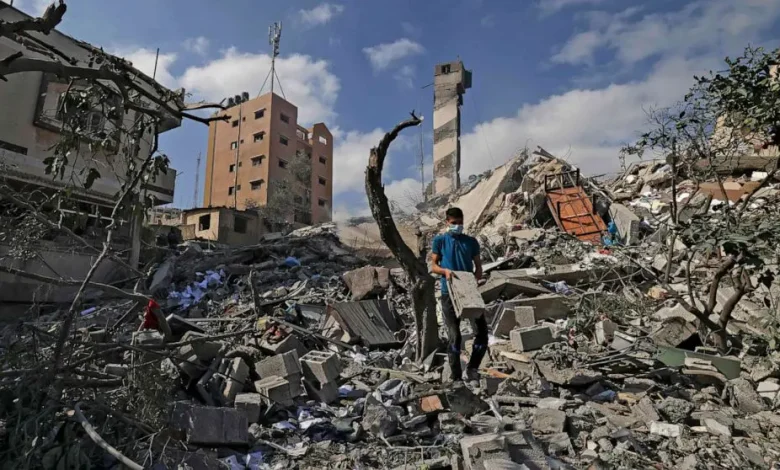
Three years after the Hamas-led October 7, 2023 attack on Israel, the Gaza Strip has been transformed beyond recognition, with vast areas reduced to rubble and millions of lives upended by a war that has reshaped the Palestinian enclave.
Israel’s sustained aerial and ground offensive has destroyed homes, neighbourhoods and vital infrastructure, severely damaging hospitals, schools, roads, water systems and other essential services.
The conflict has shattered the lives of Gaza’s roughly two million residents. Repeated evacuation orders and military operations have forced families from one location to another, leaving large numbers of Palestinians without permanent homes and dependent on humanitarian assistance.
According to Gaza’s Ministry of Health, more than 74,245 Palestinians have been killed since the war began, with thousands more injured and many others still missing or believed to be buried beneath the rubble.
The scale of the destruction extends far beyond the death toll. The United Nations and humanitarian agencies say much of Gaza’s housing stock and critical infrastructure has been damaged or destroyed, while the territory’s healthcare and education systems have been pushed towards collapse.
Life under prolonged displacement
For many Palestinians, displacement has become a permanent feature of daily life.
Families who once lived in homes, apartments and established communities now survive in tents, makeshift shelters or damaged buildings, often with limited access to clean water, electricity and sanitation.
A UN assessment cited by Al Jazeera found that, by September, 94 percent of Gaza’s population remained in urgent need of shelter and basic household assistance, while about 65 percent of households were living in tents or makeshift shelters.
The destruction has also devastated Gaza’s economy. Businesses, farms, factories and other sources of income have been damaged or destroyed, leaving unemployment at extremely high levels and reducing families’ ability to afford basic necessities.
UN figures cited in recent reporting indicate that 92 percent of Gaza’s economic establishments have been damaged or destroyed, while unemployment has reached 78 percent. Prices have also remained far above pre-war levels, further squeezing households already struggling to survive.
Healthcare system under severe strain
Gaza’s healthcare system has suffered some of the most devastating consequences of the war.
Hospitals and medical facilities have been repeatedly damaged, while those still operating face shortages of medicines, medical equipment, fuel and other essential supplies.
According to the World Health Organization, all 36 hospitals in Gaza have sustained damage, with only 19 reported to be functioning and none operating at full capacity. Thousands of patients requiring specialised treatment have also needed medical evacuation outside the territory.
The destruction of healthcare infrastructure has been compounded by overcrowding, inadequate shelter and deteriorating water and sanitation conditions, raising concerns over the spread of disease.
A generation losing access to education
The war has also disrupted the education of hundreds of thousands of children.
Schools have been damaged or destroyed, while many surviving facilities have been converted into shelters for displaced families. UNICEF estimates cited in recent reporting indicate that around 98 percent of schools have been damaged or destroyed, while about 700,000 children aged four to 17 have missed almost three consecutive years of in-person education.
The prolonged interruption has raised concerns about a generation losing years of formal education, with children increasingly relying on temporary learning spaces, makeshift classrooms and humanitarian programmes.
Ceasefire fails to end the violence
Although a ceasefire was announced in October 2025, it has not brought a complete end to the violence.
Gaza’s Ministry of Health says 1,462 Palestinians have been killed since the ceasefire took effect, while Israeli attacks and other military activity have continued across the Strip.
The continuing casualties have underscored the fragility of the truce, with disagreements over military control, security arrangements, humanitarian access and the future governance of Gaza continuing to complicate efforts to secure lasting peace.
Gaza’s future remains uncertain
Three years of war have left Gaza facing an enormous reconstruction challenge.
Beyond rebuilding homes and infrastructure, the territory must confront the loss of healthcare capacity, disrupted education, economic collapse and the psychological trauma of prolonged conflict and displacement.
For Palestinians, the October 7 anniversary is therefore not only a reminder of the attack that triggered the war, but also of the destruction and loss that followed.
Three years on, Gaza remains caught between the devastation of the past and an uncertain future, with millions of Palestinians still waiting for a durable end to the violence, a safe return to their homes and a credible path towards reconstruction and recovery.