In a bold push to safeguard the integrity of Nigeria’s currency and reinforce national values, the Economic and Financial Crimes Commission (EFCC) has launched a national sensitization campaign urging citizens to stop abusing the Naira.
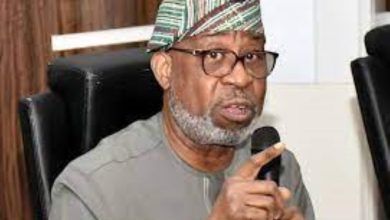
Speaking at a high-level stakeholders’ engagement in Lagos on Friday, EFCC Chairman, Ola Olukoyede, declared that actions such as spraying, mutilating, or stamping on the Naira are not cultural practices but criminal offences punishable by law.
“The Naira is more than a medium of exchange — it is a symbol of our sovereignty. Destroying it is not cultural; it is economic sabotage,” Olukoyede said.
Olukoyede revealed that the Commission, in collaboration with the Central Bank of Nigeria (CBN), has set up a dedicated task force on Naira abuse and dollarisation, aimed at clamping down on unlicensed foreign exchange dealers and individuals engaged in illegal currency practices.
He dismissed the popular justification that money spraying is a Nigerian tradition, asserting:
“Nobody who works hard for money would throw it into the air. That’s not tradition — that’s an offence.”
Addressing criticism that the EFCC should focus only on high-profile corruption, Olukoyede emphasized the Commission’s equal commitment to all forms of illegality:
“An offence is an offence. Ignorance of the law is no excuse. Some celebrities already facing prosecution understand this clearly.”
He stressed that the EFCC’s current strategy balances robust enforcement with economic recovery and investment protection:
“We no longer indiscriminately shut down companies under investigation. Our operational model now considers the need to preserve jobs and support economic stability.”
The EFCC Chairman disclosed that more than ₦100 billion recovered from corruption cases under his leadership has been channeled into key social programmes under the Tinubu administration, including the Nigeria Education Loan Fund and CrediCorp consumer credit initiative.
He cited notable recoveries and redeployments of assets, including:
A property recovered from a former civil servant in Kaduna, now repurposed as the Federal University of Applied Sciences, Kachia.
A skill acquisition centre and liaison office in Bayelsa made possible through funds recovered from the Niger Delta Development Commission (NDDC).
Additionally, the Commission has continued restitution efforts in collaboration with international partners, refunding victims of fraud in the United States, Spain, and Canada.
Olukoyede revealed that recent sting operations in Lagos and Abuja led to the arrest of 792 suspects, many allegedly linked to international cybercrime syndicates. Over 150 suspects, including Chinese nationals, have been successfully prosecuted.
He also reaffirmed the EFCC’s commitment to holding politically exposed persons (PEPs) accountable:
“Currently, four former governors and three ex-ministers are standing trial for various corruption-related offences. We are not backing down.”
To address financial crimes at their root, Olukoyede announced the creation of a Department of Fraud Risk Assessment and Control, designed to identify and neutralize vulnerabilities before fraud can occur.
He also touted the Commission’s growing media footprint, including the launch of EFCC Radio 97.3 FM and weekly sensitization campaigns on TV, radio, and X Spaces (formerly Twitter).
“We all must lend our voices to this campaign. The responsibility to preserve the dignity of the Naira does not lie with the EFCC alone — it is a shared national duty,” he concluded.