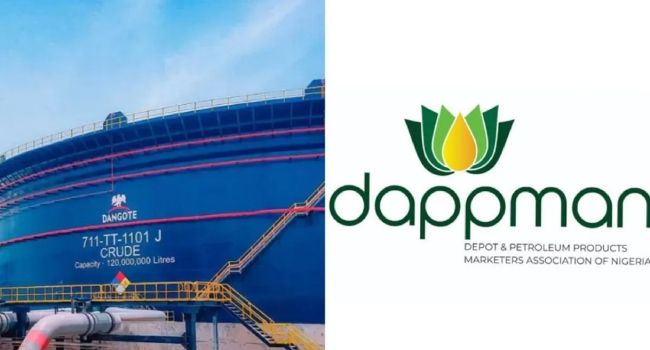
Petroleum marketers say fresh court action by Dangote Refinery threatens industry stability, fuel supply security, and billions invested in Nigeria’s downstream oil sector…..
The Depot and Petroleum Products Marketers Association of Nigeria has strongly opposed a fresh legal action filed by the Dangote Petroleum Refinery seeking to nullify fuel import licences issued by the Nigerian Midstream and Downstream Petroleum Regulatory Authority to petroleum marketers and other importers.
The dispute marks another escalation in the growing tension between Dangote Refinery and fuel importers over control of Nigeria’s downstream petroleum market.
According to court filings reportedly seen by Reuters, the refinery asked the Federal High Court in Lagos to invalidate import permits granted by the NMDPRA, arguing that the approvals contradict the spirit of the Petroleum Industry Act, which prioritises local refining and allows imports mainly in cases of supply shortages.
Although the refinery had previously withdrawn a similar case from court, the latest move signals a renewed push to challenge the continued issuance of fuel import licences despite the commencement of domestic fuel supply from the 650,000 barrels-per-day refinery.
Dangote Refinery has repeatedly argued that continued petrol importation discourages local refining investments, weakens domestic production capacity, and sustains dependence on foreign fuel supplies even when local alternatives exist.
However, DAPPMAN insists that the import licences are lawful instruments issued under the Petroleum Industry Act to protect Nigeria’s fuel supply chain and maintain market stability.
In a statement released on Sunday, the association warned that it would not stand by while businesses that invested heavily in Nigeria’s downstream sector are threatened by legal attempts to invalidate their operating framework.
According to the marketers, billions of naira have already been committed to petroleum depots, logistics infrastructure, distribution systems, and regulatory compliance based on the understanding that the licences granted by the NMDPRA are legally protected.
The association argued that retroactively cancelling those approvals could create uncertainty across the entire downstream oil industry at a sensitive period for fuel supply management.
“The import licences at the centre of this lawsuit are not administrative courtesies,” the group stated.
“They are the legal instruments through which Nigeria’s fuel supply chain functions.”
DAPPMAN further defended the role of the regulator, maintaining that the NMDPRA acted within its statutory authority by issuing the licences in line with the provisions of the Petroleum Industry Act.
According to the association, the regulator’s primary responsibility is to ensure uninterrupted fuel availability for Nigerians rather than protect the commercial interests of any single refinery, regardless of its size or market influence.
The latest controversy also follows recent approvals granted to marketers to import more than 600,000 metric tonnes of petrol into Nigeria.
While Dangote Refinery views such approvals as unnecessary given its domestic refining capacity, marketers argue that maintaining multiple supply channels remains critical to protecting the country from shortages and market disruptions.
DAPPMAN also warned against any attempt to turn Nigeria’s downstream petroleum market into a monopoly, stressing that the sector has evolved over decades into a competitive multi-player system serving millions of consumers nationwide.
The group maintained that reducing the number of active market participants could ultimately hurt consumers through reduced competition, pricing distortions, and increased supply vulnerabilities.
“We respect Dangote Petroleum Refinery’s right to pursue legal remedies,” the association said.
“What we do not accept is the premise that a private refinery’s commercial interests should override a regulatory authority’s mandate to ensure adequate supply to Nigerian consumers.”
The marketers added that they would engage legal counsel, coordinate with affected member companies, and formally challenge the lawsuit before relevant authorities and the courts.
DAPPMAN insisted that the long-term strength of Nigeria’s downstream petroleum industry depends on preserving competition and maintaining broad participation across the supply chain.
According to the association, any move aimed at shrinking the field of operators could eventually work against the interests of ordinary Nigerians who rely on stable and competitive fuel supply systems.
“Our members did not build this industry to watch it be argued out of existence in a courtroom,” the statement added.