Fresh tensions in the Middle East rattled investors on Monday, sending oil prices and global bond yields sharply higher as fears of prolonged supply disruptions and rising inflation gripped financial markets….
Global financial markets came under renewed pressure on Monday after a series of drone attacks in the Gulf intensified geopolitical tensions and triggered fresh concerns over energy supply disruptions.
Investor anxiety deepened after a drone strike sparked a fire at a nuclear power facility in the United Arab Emirates, while authorities in Saudi Arabia said they intercepted three separate drones.
The developments came as U.S. President Donald Trump warned that Iran needed to move “fast” toward reaching a deal, adding to uncertainty surrounding the region.
Markets were further unsettled by the continued disruption in the Strait of Hormuz, one of the world’s most strategic shipping routes for oil and gas exports. Shipping traffic through the waterway remains severely restricted as Tehran moves to tighten its grip over the passage, which normally handles about 20 per cent of global oil and gas trade.
The worsening tensions pushed crude prices higher, with Brent crude rising about one per cent to trade near $110.50 per barrel, while U.S. West Texas Intermediate crude climbed 1.2 per cent to around $106.72 per barrel.
Longer-dated oil futures also surged as traders prepared for the possibility of prolonged shortages. September crude contracts crossed the $100 mark, while December contracts climbed to fresh highs amid expectations that supply disruptions could persist for months.
Attention is now turning to Paris, where finance ministers and central bank governors from the Group of Seven are scheduled to meet to discuss the fallout from the Strait of Hormuz crisis and growing concerns over access to critical raw materials.
However, analysts say geopolitical divisions among member states could complicate efforts to present a unified response.
The spike in energy prices also rattled global bond markets, with investors increasingly worried that sustained increases in fuel and transportation costs could reignite inflation pressures worldwide.
Yields on benchmark U.S. 10-year Treasury notes climbed to 4.631 per cent the highest level in 15 months after surging sharply last week. U.S. 30-year bond yields also advanced beyond 5.1 per cent as investors demanded higher returns amid inflation fears.
In Asia, Japan’s 10-year government bond yield rose to its highest level since 1996 after Tokyo proposed issuing fresh debt to support an emergency spending package aimed at cushioning the economic impact of the Iran conflict.
Germany’s 10-year bond yield also climbed to levels not seen in over a decade, reflecting growing stress across European debt markets.
Equity markets reacted negatively to the latest developments.
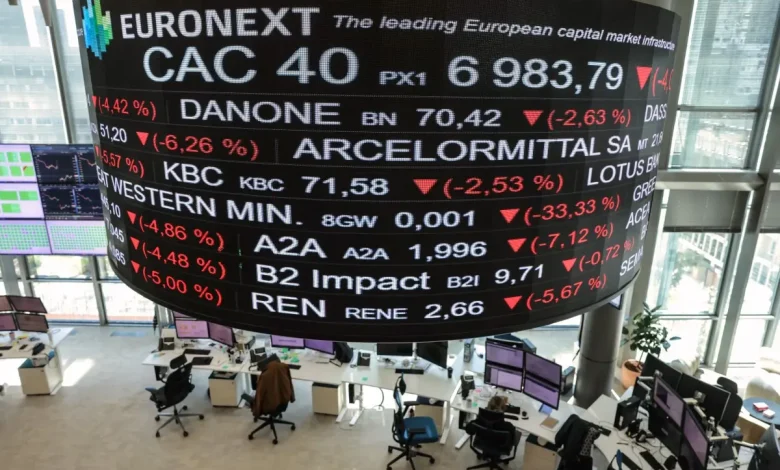
European shares fell broadly, with major indexes in Frankfurt, Paris, and London posting losses of up to 1.1 per cent.
Asian markets were also weaker. Japan’s Nikkei index slipped one per cent after retreating from recent record highs, while Chinese blue-chip stocks declined following disappointing economic data from Beijing.
China’s April retail sales growth came in far below expectations, while industrial production also slowed, raising additional concerns about weakening global demand.
In the United States, futures tied to the S&P 500 and Nasdaq moved lower as investors reassessed inflation risks and the potential impact of rising oil prices on corporate earnings and interest rates.
Currency markets also reflected the growing caution among investors.
The euro remained relatively stable after suffering heavy losses last week, while the British pound stayed under pressure amid renewed political uncertainty in the United Kingdom and concerns over volatility in the gilt market.
The U.S. dollar continued to strengthen against the Japanese yen, with traders closely watching the possibility of intervention by Japanese authorities to stabilise the currency.
Meanwhile, gold prices were little changed despite the escalating geopolitical tensions, suggesting investors remain uncertain about the precious metal’s role as a reliable inflation hedge under current market conditions.