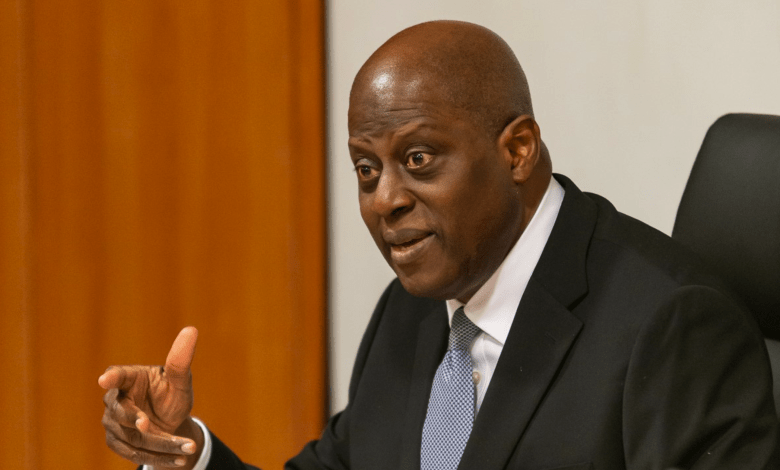
The Governor of the Central Bank of Nigeria (CBN), Olayemi Cardoso, has raised fresh concerns over the inflationary risks tied to rising liquidity levels in the financial system, cautioning that growing fiscal disbursements through the Federation Account Allocation Committee (FAAC) could undermine the apex bank’s efforts to tame inflation unless countered with tighter monetary policies.
Cardoso issued the warning in his personal commentary published following the CBN’s 300th Monetary Policy Committee (MPC) meeting held on May 20, 2025. The remarks, made public on the Bank’s official website on Saturday, underscore the CBN’s growing unease with the scale of naira liquidity entering the economy.
“We are also confronted with increased liquidity injections into the banking system from statutory revenue distributions,” Cardoso said, stressing the “need for tight monetary conditions to avoid renewed inflationary pressures.”
His comments reflect concern that expanding FAAC allocations to the federal, state, and local governments could increase the volume of naira in circulation effectively fueling demand in an economy still grappling with limited supply and fragile recovery conditions.
FAAC Disbursements Hit ₦1.818 Trillion in June
Cardoso’s remarks come on the heels of fresh fiscal data from FAAC, which reported that ₦1.818 trillion was shared among the three tiers of government in June 2025, a 9.6% increase from the ₦1.659 trillion distributed in May.
According to the FAAC breakdown:
- Statutory revenue accounted for ₦1.018 trillion
- Value Added Tax (VAT) brought in ₦631.507 billion
- Electronic Money Transfer Levy contributed ₦29.165 billion
- Exchange difference revenue added ₦38.849 billion
- An additional ₦100 billion came from non-mineral sources as augmentation
From the total distributed, the Federal Government received ₦645.383 billion, states got ₦607.417 billion, and local governments took ₦444.853 billion. Oil-producing states received an extra ₦120.759 billion as 13% derivation revenue.
The Office of the Accountant-General of the Federation also reported that gross revenue for June reached ₦4.232 trillion, out of which ₦162.786 billion was deducted as collection costs, while ₦2.251 trillion was allocated for transfers, refunds, and fiscal interventions.
Liquidity Threatens Disinflation Momentum
The CBN’s core concern is that these growing fiscal injections may lead to excess liquidity, which could, in turn, stoke inflation reversing the modest gains made in recent months.
Headline inflation has been gradually declining, according to data from the National Bureau of Statistics (NBS). As of June 2025, Nigeria’s annual inflation rate had eased to 22.22%, down from 22.97% in May. This also reflects a significant drop from 34.19% in June 2024 a near 12-point fall that many attribute to the CBN’s aggressive monetary tightening.
However, inflation momentum remains uneven. Month-on-month inflation actually rose to 1.68% in June, up from 1.53% in May, signaling that price pressures may be accelerating again after a brief slowdown.
Monetary Policy Outlook: Steady or Slightly Looser?
As the CBN gears up for its next MPC meeting, economists and investors are closely watching for signs of any policy shift. Most analysts expect the Bank to hold the Monetary Policy Rate (MPR) at 27.5% for the third straight time, aiming to strike a delicate balance between price stability and economic growth.
However, some market watchers anticipate a modest rate cut to 27.25%, potentially accompanied by a slight adjustment to the asymmetric corridor a move that would signal the Bank’s willingness to respond to evolving macroeconomic conditions without fully relaxing its inflation-fighting stance.
Regardless of the outcome, Cardoso’s warning underscores the CBN’s ongoing focus on monetary discipline, even as fiscal dynamics inject fresh complexity into Nigeria’s economic landscape.