
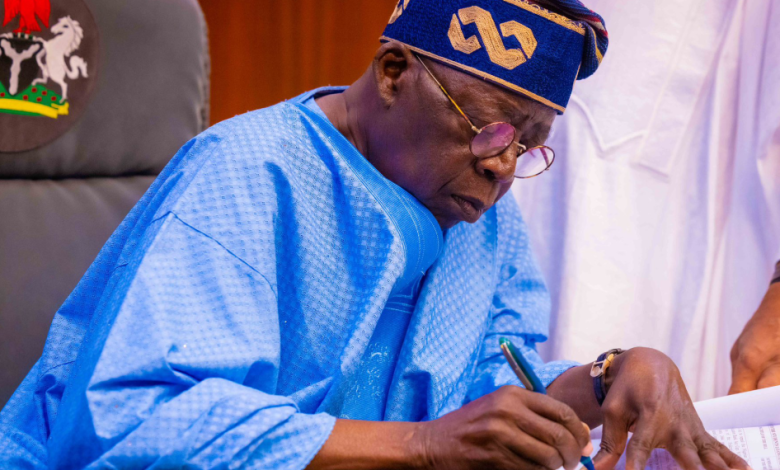
President warns high borrowing costs are starving Africa’s industries as he pushes for global financial reforms at Nairobi summit….
President Bola Tinubu has disclosed that Nigeria is expected to spend about $11.6 billion servicing debt obligations in 2026, describing the burden of high-interest borrowing as a major obstacle to industrial growth across Africa.
Tinubu made the remarks on Tuesday while leading Nigeria’s delegation to the Africa Forward Summit held at the Kenyatta International Convention Centre in Nairobi, Kenya.
According to a statement issued by presidential spokesman Bayo Onanuga, the President said nearly half of Nigeria’s projected revenue for 2026 could go into debt servicing, leaving limited resources for industrial expansion and economic development.
Tinubu warned that the current global financial structure places African economies at a disadvantage by making access to affordable financing extremely difficult.
“Every dollar spent on punitive interest payments is money that cannot go into manufacturing, infrastructure, agriculture, energy or technology,” the President said while addressing African leaders, diplomats and business executives at the summit.
He argued that African countries are unfairly classified as high-risk economies despite ongoing fiscal reforms and economic restructuring efforts across the continent.
According to him, the high cost of borrowing has weakened Africa’s ability to industrialise and compete with developed economies.
“How can African manufacturers compete globally when borrowing costs are several times higher than what businesses in Europe, Asia or North America pay?” he asked.
Tinubu said Nigeria was not asking for financial handouts but demanding a fairer international system that allows African countries to process their raw materials locally, refine crude oil, manufacture goods and build stronger industrial economies.
He stressed that the continent could not continue exporting raw materials while importing finished products at premium prices.
The President also renewed his call for reforms in the global financial system, insisting that existing structures continue to frustrate Africa’s economic transformation.
He noted that despite decades of independence, Africa still accounts for less than two per cent of global manufacturing output.
Tinubu said Nigeria had taken difficult economic decisions to reposition its economy, including the removal of fuel subsidies, exchange rate unification, recapitalisation of the banking sector and efforts to improve financial transparency.
According to him, those reforms were made independently and not imposed by foreign institutions.
He stated that the reforms had already begun yielding results, including stronger foreign reserves, improving investor confidence and a projected debt-to-GDP ratio of 32.3 per cent in 2026.
The President disclosed that Nigeria’s external reserves had risen to about $45.5 billion, while the banking recapitalisation drive had attracted over $3.4 billion.
Beyond economic reforms, Tinubu also highlighted Nigeria’s plans to strengthen maritime security and expand opportunities within the blue economy sector.
He announced that Nigeria would make its Deep Blue Project maritime intelligence infrastructure available as a shared regional platform for willing Gulf of Guinea nations in a bid to improve cooperation against maritime crimes and insecurity.
Tinubu said secure waters, effective regulation and stronger institutions were critical to attracting private investment into Africa’s maritime sector.
He added that Nigeria was positioning itself for climate-friendly port development and digital transformation within the maritime industry.
On migration, the President argued that the growing wave of irregular migration from Africa could only be addressed by creating economic opportunities at home.
He said people would be less likely to embark on dangerous migration routes if jobs, infrastructure and economic stability improved within African countries.
Tinubu called on international partners to increase investments in climate adaptation, digital skills, energy access and sectors capable of creating large-scale employment opportunities for African youths.
He also advocated stronger collaboration between African nations in shaping migration policies and governance frameworks globally.
The Africa Forward Summit, jointly hosted by French President Emmanuel Macron and Kenyan President William Ruto, brought together leaders, policymakers and investors from more than 30 countries to discuss industrialisation, investment, technology, climate change and economic growth across Africa.
During the event, Tinubu also held separate meetings with Madagascar’s President Michael Randrianirina and CAF President Patrice Motsepe, where he reaffirmed Nigeria’s readiness to host the 2026 CAF Awards.
Several top Nigerian government officials and business leaders accompanied the President to the summit, including ministers overseeing finance, agriculture, communications, industry and marine economy, alongside prominent entrepreneurs such as Aliko Dangote, Tony Elumelu, Abdulsamad Rabiu and Aigboje Aig-Imoukhuede.


