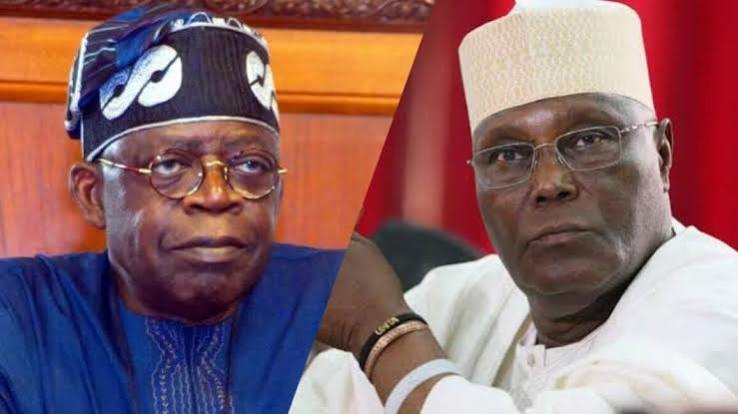
President Bola Tinubu has criticised former Vice President Atiku Abubakar’s proposal to restore petrol subsidy if elected president in 2027, describing the policy as a sign of a poor understanding of governance and economic realities.
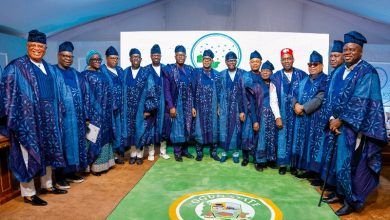
Tinubu spoke on Thursday at the State House in Abuja while receiving Osun State Governor Ademola Adeleke, who recently secured a second term in office.
The President argued that the return of petrol subsidy would reverse the gains of his administration’s reforms, recalling that before the subsidy was removed, several state governments struggled to meet their salary obligations and frequently relied on financial assistance from the Federal Government.
According to Tinubu, the subsidy regime placed significant pressure on public finances and contributed to fiscal difficulties across the states.
He urged Adeleke to use his renewed mandate to reconcile with political opponents and promote peace, unity, stability and the rule of law in Osun State.
Tinubu said Adeleke’s victory should be viewed as an opportunity to strengthen democratic institutions and unite the people, rather than deepen political divisions.
Speaking after the meeting, Adeleke said his visit was primarily to thank the President for what he described as the Federal Government’s role in ensuring that the outcome of the August 15 governorship election reflected the will of the electorate.
Atiku’s Subsidy Position Under Scrutiny
Atiku’s proposal to restore petrol subsidy has also revived scrutiny of his earlier positions on the policy.
The former vice president had, in several statements between 2020 and 2023, advocated the removal of fuel subsidy and the liberalisation of the downstream petroleum sector.
At the time, Atiku argued that subsidy and government-controlled petrol pricing encouraged corruption, discouraged investment and placed an unsustainable burden on public finances.
He also supported a transition towards market-based pricing, while calling for savings from subsidy removal to be redirected into domestic refining, infrastructure and other productive sectors.
Atiku had previously pointed to his role in the Olusegun Obasanjo administration, when he participated in negotiations with organised labour over efforts to progressively remove fuel subsidy.
His latest proposal therefore marks a significant shift from his earlier position and has intensified the political debate over how Nigeria should manage petrol pricing and energy subsidies.
Presidency Rejects Atiku’s Proposal
The Presidency has also rejected Atiku’s plan, arguing that restoring the subsidy regime would be fiscally unsustainable and inconsistent with the structural changes that have taken place in Nigeria’s petroleum industry since 2023.
In a statement issued by Special Adviser to the President on Information and Strategy, Bayo Onanuga, the Presidency said Atiku’s proposal failed to adequately address how the subsidy would be financed or implemented under the current petroleum-market framework.
The Presidency argued that the subsidy was not simply government assistance sitting in the treasury, but the absorption of the difference between the actual cost of supplying petrol and the regulated pump price, which generated substantial costs for the public sector.
It also noted that the Petroleum Industry Act had already provided for the removal of petrol subsidy, with the Tinubu administration accelerating the process in 2023.
The Presidency further contended that Nigeria’s petroleum landscape has changed considerably since then, particularly with the emergence of large-scale domestic refining capacity.
It pointed to the Dangote Refinery as a major development that has increased local petrol production and reduced the country’s reliance on imported refined petroleum products.
According to the Presidency, restoring a broad-based subsidy could undermine private investment in refining, increase pressure on government finances and reverse the shift towards a more market-driven downstream petroleum sector.
The administration also maintained that removing the subsidy has strengthened revenues available to the Federal, state and local governments, allowing the three tiers of government to receive larger allocations from the Federation Account.
The Presidency therefore urged Nigerians to assess Atiku’s proposal against the current economic and petroleum-market realities, particularly its potential fiscal cost, legal implications and impact on domestic refining.
The renewed clash over petrol subsidy is expected to become a major economic issue ahead of the 2027 presidential election, with both camps offering sharply different visions for Nigeria’s energy policy, public finances and the future of the downstream petroleum sector.