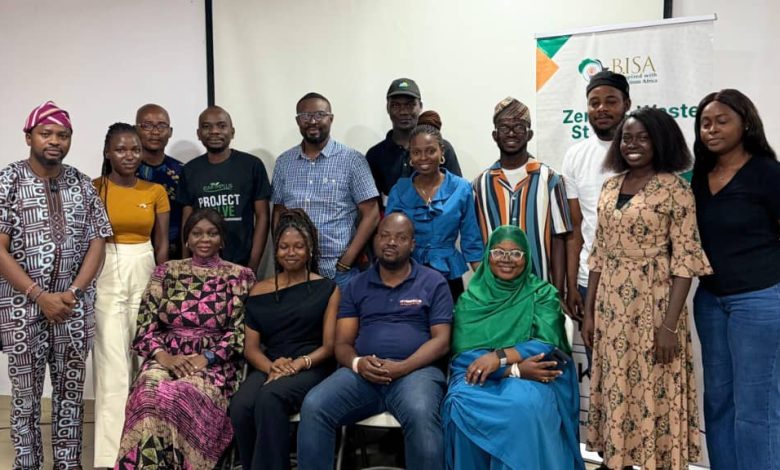
Nigerian organisations working in waste management, plastic pollution and environmental sustainability are being equipped with stronger storytelling and communication skills to help showcase solutions to the country’s growing environmental challenges.
The training was organised under the Zero Waste Stories Bank Phase Two, an initiative designed to help organisations document and communicate practical zero-waste and circular economy solutions emerging from communities.
Organisations working across Nigeria’s environmental and waste-management sectors gathered for the Zero Waste Stories Bank Phase Two Storytelling Workshop, aimed at strengthening their ability to turn local environmental experiences into compelling stories capable of reaching wider audiences.
The initiative is part of the Zero Waste Stories Bank Project, organised by B.Inspired with Stories from Africa, B.ISA, a storytelling organisation based in Accra, Ghana.
The Nigerian workshop was implemented by the International Climate Change Development Initiative, ICCDI Africa, through B.ISA, with support from the UMI Fund.
The second phase of the programme extends the initiative to Nigeria, Kenya and Egypt, building on the first phase, which involved organisations in Ghana, Uganda and Botswana.
The training focused on one central idea — environmental organisations should not only tell people about problems; they should also tell the stories of people and communities developing solutions.
Participants examined how issues such as plastic pollution, open dumping, food waste, inadequate waste collection and blocked drainage systems can be transformed into human-centred stories that inform, engage and inspire action.
The training also highlighted the importance of combining personal experiences with credible information and evidence to make environmental stories both compelling and trustworthy.
A major session focused on digital storytelling and story distribution channels, where participants explored how environmental stories can be developed for platforms including Facebook, Instagram, TikTok, YouTube and LinkedIn, as well as traditional media.
Participants were encouraged to first identify their target audience before choosing the appropriate platform and format for their stories.
The objective is to ensure that environmental stories reach the people who can influence change — from policymakers and development partners to businesses, communities and young people.
The workshop also explored the circular economy and how organisations can change the way waste is presented to the public.
Facilitated by Olumide Idowu, Co-Founder and CEO of ICCDI Africa, the session examined how activities such as recycling, reuse, repair, waste-to-wealth initiatives, sustainable production and responsible consumption can create economic opportunities while protecting the environment.
The focus was on helping organisations communicate the wider value of their work — including job creation, livelihoods, enterprise development, public health and environmental protection.
From the classroom, participants moved into practical storytelling exercises.
Using the Cha Cha Cha Storytelling Training Guide, participants worked in groups to develop and film short zero-waste stories using their smartphones.
Their stories explored issues including plastic pollution, open dumping, blocked drainage channels, food waste, recycling livelihoods and innovative approaches to recovering value from discarded materials.
The exercise demonstrated that impactful environmental storytelling does not necessarily require expensive production equipment.
With a clear storyline, a strong human angle and basic digital tools, organisations can document solutions within their communities and distribute them to wider audiences.
For participants, the training also highlighted the importance of making environmental solutions more visible.
Across Nigeria, communities, entrepreneurs and organisations are already developing responses to waste and environmental challenges. However, many of these interventions remain largely unknown outside the communities where they operate.
Strategic storytelling can help bridge that visibility gap by connecting grassroots initiatives with policymakers, businesses, development partners, the media and other communities.
The workshop ended with an awards ceremony to recognise participants and organisations that demonstrated strong engagement and creativity throughout the programme.
Brahamot Global Enterprise emerged as the best-performing company and received a 100-dollar award in recognition of its performance and contribution to the programme.
As the Zero Waste Stories Bank enters its second phase across Nigeria, Kenya and Egypt, organisers say strengthening the ability of environmental organisations to communicate their work is essential to ensuring that effective solutions receive the attention and support they deserve.
For Nigeria’s growing zero-waste movement, the message from the workshop is clear: solving environmental problems is only part of the work.
Documenting those solutions, putting people at the centre of the story and communicating their impact can help turn local innovation into wider environmental and economic change.