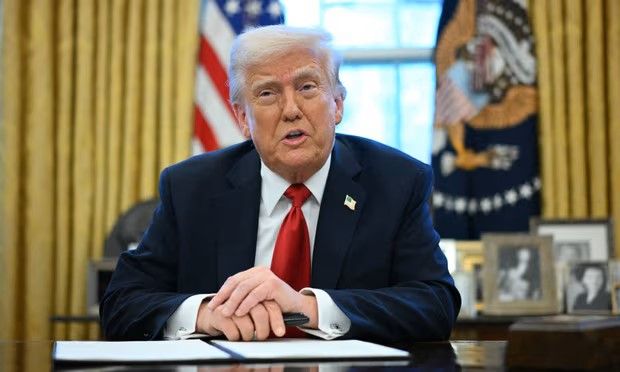
U.S. President Donald Trump has turned to the Supreme Court, seeking to reverse a recent lower court ruling that declared several of his administration’s tariffs unlawful.
In a petition filed late Wednesday, Trump’s legal team urged the justices to urgently review the case, arguing that the president has the authority to impose broad import duties in response to threats to the U.S. economy and national security.
The appeal follows a 7-4 decision by the U.S. Court of Appeals for the Federal Circuit last week, which ruled that the tariffs Trump imposed under the International Emergency Economic Powers Act (IEEPA) exceeded presidential authority. The court found that setting tariffs falls squarely within the power of Congress, not the executive branch.
Case Could Trigger Billions in Refunds, Shake Foreign Policy
The outcome of the case could carry massive implications for U.S. trade policy and Trump’s broader economic agenda, potentially forcing the federal government to refund billions of dollars in tariffs collected from businesses across the country.
At the heart of the legal dispute is Trump’s 2020 declaration of an economic emergency, in which he cited trade imbalances and declining U.S. manufacturing as threats justifying executive action under the IEEPA. His administration then imposed a 10% baseline tariff, along with “reciprocal tariffs” on imports from over 90 countries, including China, Canada, and Mexico.
While a federal trade court and the appeals panel ruled the actions unconstitutional, they temporarily delayed enforcement of the decision to allow time for the appeal process to play out. That delay now hinges on whether the Supreme Court agrees to hear the case before the ruling takes effect on October 14.
Administration: Ruling Threatens National Security
In the petition to the Supreme Court, Solicitor General John Sauer warned that the appeals court’s ruling could jeopardize ongoing international negotiations and compromise the government’s ability to respond to future economic threats.
“The stakes in this case could not be higher,” Sauer wrote. “The lower court’s erroneous decision has disrupted highly impactful, sensitive, ongoing diplomatic trade negotiations, and cast a pall of legal uncertainty over the President’s efforts to protect our country.”
The Trump team insists that the tariffs were a lawful and necessary response to what it described as an “unprecedented economic and foreign policy crisis.”
Small Businesses Push Back
On the other side, a coalition of small businesses and U.S. states have challenged the tariffs, claiming they were unlawfully imposed and financially damaging to entrepreneurs across the country.
“These unlawful tariffs are inflicting serious harm on small businesses and jeopardising their survival,” said Jeffrey Schwab, an attorney with the Liberty Justice Center, which represents several business plaintiffs. “We hope for a prompt resolution of this case for our clients.”
Their legal efforts have already produced a separate ruling from the New York-based Court of International Trade, which declared the tariffs illegal in May, a decision that also remains on hold pending appeals.
What’s at Stake?
If the Supreme Court declines to take up the case, the Federal Circuit’s ruling will come into effect next month, effectively striking down tariffs on dozens of countries and reshaping the legal boundaries of presidential economic powers.
Notably, the current appeals court decision does not affect other tariffs imposed by Trump under separate authorities such as those on steel and aluminum, which were enacted under national security provisions of the Trade Expansion Act.