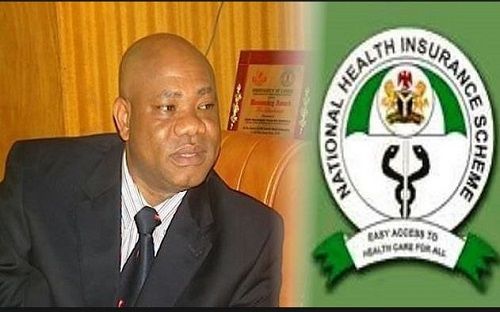
The Federal Government has filed an appeal challenging the July 24 judgment of the Federal High Court in Lagos, which acquitted former Executive Secretary of the National Health Insurance Scheme (NHIS), Olufemi Thomas, of multiple counts of money laundering involving $2.1 million.
In a 28-page notice of appeal filed before the Lagos Division of the Court of Appeal, federal prosecutors laid out 11 grounds against the decision rendered by Justice Olayinka Faji, who had discharged and acquitted Thomas on five out of six counts filed by the Economic and Financial Crimes Commission (EFCC).
In the contested ruling, Justice Faji held that the prosecution failed to prove its case beyond reasonable doubt, and noted that the EFCC admitted during trial that it did not investigate several claims made by the defendant, including the sources of his income.
The court further ruled that no case of unlawful enrichment was established.
However, Thomas was convicted on count five for making a cash payment above the ₦5 million legal threshold, in violation of anti-money laundering laws.
He was fined ₦10 million, and the court ordered the return of the seized $2.1 million to him within 14 days, upon payment of the fine.
Dissatisfied, the EFCC, through its lead counsel Ekele Iheanacho (SAN), argued that the trial court erred in law and based its decision on what it described as “imaginary and fanciful doubt,” rather than the weight of documentary and oral evidence presented.
The Commission contended that it had proven a prima facie case and that Thomas had failed to offer a consistent or reasonable explanation for the sudden and significant increase in his financial assets. It further invoked Section 19(5) of the EFCC Act, which places the burden of proof on an accused to account for wealth that is disproportionate to known income sources.
“At the close of the prosecution’s case, the trial court agreed that a prima facie case had been established. The burden then shifted to the defendant to explain the source of $2,198,000. Unfortunately, his explanation was contradictory, inconsistent, and unconvincing,” the EFCC argued.
The anti-graft agency also criticised the court’s refusal to order forfeiture of the funds, which it described as proceeds of crime and instrumentality of criminal activity.
“The learned trial judge ignored uncontroverted evidence that the defendant’s private businesses—such as his farm—paid no taxes, and that aside from his earnings as a public servant, he had no traceable, legal income sources,” the EFCC stated.
The Commission maintained that allowing Thomas to reclaim the funds amounts to rewarding illegality and undermines the integrity of Nigeria’s anti-corruption framework.
Consequently, the EFCC is asking the appellate court to set aside parts of the trial court’s judgment, convict the defendant on the remaining counts, and order the permanent forfeiture of the $2,198,000 to the Federal Government of Nigeria.
The appeal is expected to set a major legal precedent in Nigeria’s fight against illicit financial flows and unexplained wealth, particularly among former public officials.