Billionaire says $16bn Kenyan refinery will be a starting point for wider industrial development as Africa seeks to retain more value from its natural resources…..
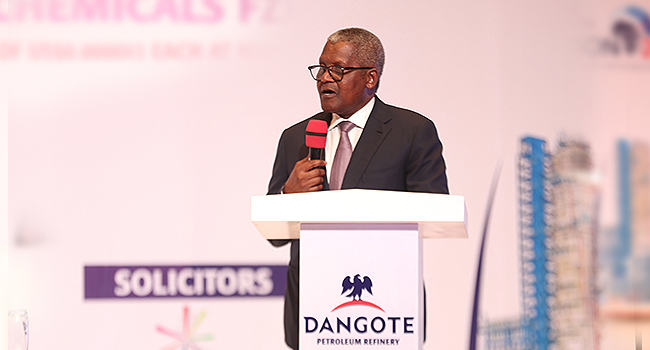
Africa could meet most of its refined petroleum needs from within the continent by 2030, according to Nigerian industrialist Aliko Dangote.
Dangote made the projection in Nairobi on Tuesday, a day before the formal groundbreaking of a planned $16 billion refinery on Kenya’s Indian Ocean coast.
The proposed facility, to be located in Lamu, is expected to have a refining capacity of 700,000 barrels per day and take about 30 months to complete.
For Dangote, the project forms part of a broader push to reduce Africa’s dependence on imported finished products and increase the processing of the continent’s raw materials locally.
Responding to questions from journalists about when African countries could stop relying on fuel imports from outside the continent, Dangote said the bulk of the continent could become self-sufficient by the end of the decade.
“By 2030, the majority of African countries will be self-sufficient. It does not matter where it is refined, but it should be in the African continent, on the soil of Africa.”
Dangote dismisses concerns over Kenya project
The Kenyan refinery is being developed amid legal and environmental concerns.
A land rights case has been brought against the project, while environmental groups, including Greenpeace, have raised objections over its potential impact on the coastal environment.
Dangote dismissed the concerns, arguing that opposition to major industrial projects should not prevent Africa from pursuing economic development.
“There’s actually no problem with these sort of cases,” he said. “There are people who don’t want the development of Africa.”
Where will the refinery get its crude?
The availability of crude oil has also raised questions about the planned refinery, particularly because East Africa’s oil industry is still developing.
Kenya, Tanzania and Mozambique are among the countries in the region seeking to expand their oil and gas production, but Dangote said the refinery would not depend exclusively on local crude supplies.
He said the company would source crude from several international markets, including the Middle East and the United States, while positioning the refinery to take advantage of increased African production in the future.
Dangote argued that Africa could not afford to wait for its oil production to expand before investing in the infrastructure needed to meet future demand.
“Are we going to wait until (Africa has) one quarter of the world’s population before we start thinking of what to do? We have to start addressing that issue today.”
He also pointed to US President Donald Trump’s reported threats to restrict diesel exports as another reason for African countries to develop greater control over their energy supply.
$16bn refinery described as ‘just the start’
Despite its planned 700,000-barrel-per-day capacity, Dangote said the Kenyan refinery would represent only an initial step in a much larger industrial project.
He said the facility would be significant for East Africa but relatively small compared with the continent’s potential future demand for refined products.
“When you talk about 700,000 barrels per day, it’s actually small. For the region, it’s a big refinery, it’s a big investment, but it is a start-up,” he said.
Dangote added that the refinery was expected to attract other industries and investments to the area.
“This refinery is not all we are going to do there. It’s just the start… You will see the number of industries that will come around the refinery.”
Dangote targets Africa’s raw-material export model
Beyond fuel production, Dangote said Africa needed to change the way it generates economic value from its natural resources.
He argued that exporting raw materials while importing finished goods means much of the economic benefit including jobs is created outside the continent.
“The biggest problem is that we export raw materials at maybe 5 to 10 percent of its value, and then we end up buying at 100 percent of its value,” he said.
According to Dangote, greater local processing would allow African economies to capture more of the value generated from their resources.
“We are exporting jobs, because when we keep exporting raw materials, you are creating jobs out there. And when you buy finished products from them… you are importing poverty, because you are not actually creating any jobs here.”
The Kenyan refinery is expected to break ground on Wednesday, marking the beginning of what Dangote described as a broader industrial push around the facility.