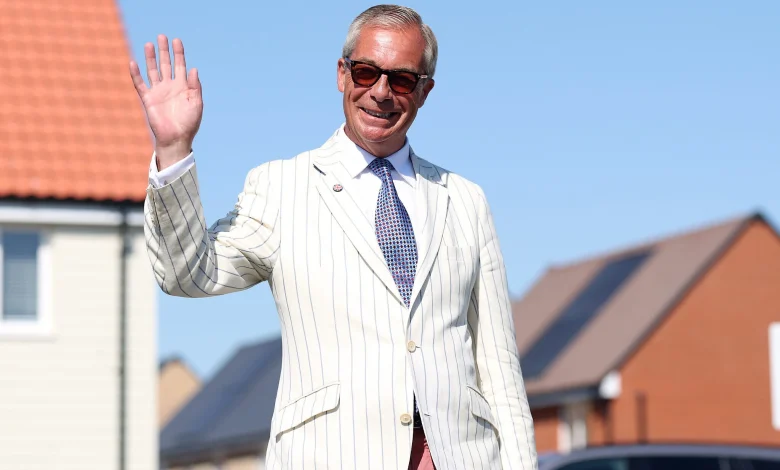
Reform UK leader Nigel Farage has reclaimed his seat in the British Parliament after comfortably winning the Clacton by-election, defeating his closest challenger, satirical candidate Count Binface, in an unusual contest boycotted by the country’s major political parties.
Farage secured 22,239 votes, representing about 63 percent of the ballots cast, while Count Binface, the comic persona of Jonathan David Harvey who campaigns wearing a large rubbish bin on his head, finished a surprising second with 9,455 votes, or roughly 27 percent.
The result restores Farage to the House of Commons just weeks after he resigned the Clacton seat himself, triggering the by-election. His decision came amid scrutiny over his financial affairs, including questions surrounding an undeclared £5 million gift linked to cryptocurrency businessman Christopher Harborne.
Farage had sought to use the by-election as a fresh test of his popularity among Clacton voters and as an opportunity to demonstrate that allegations surrounding his finances had not weakened his political support.
However, the campaign quickly became an unusual political spectacle after Labour, the Conservatives, Liberal Democrats and other major parties declined to contest the seat. Their absence left Farage facing a field dominated by independents, fringe candidates and political satirists.
The election attracted a record 34 candidates, the highest number ever recorded in a UK parliamentary election, according to Tendring District Council.
Count Binface emerged as the unexpected beneficiary of the extraordinary contest. His nearly 9,500 votes represented by far his strongest electoral performance since he first began contesting elections in 2019. His campaign mixed satire with unconventional proposals, including price controls on everyday items and quirky local pledges.
Despite his victory, Farage did not attend the official declaration of the result and cancelled his planned victory speech. He had earlier cited security concerns after being warned about a possible attempt to disrupt the count, although reports noted that the alleged threat had not been independently substantiated by Essex Police.
The Reform UK leader nevertheless celebrated the result as a decisive endorsement from Clacton voters, portraying it as a rejection of the political establishment and criticism directed at him by sections of the British media.
The election recorded a 44 percent turnout, significantly below the 59 percent recorded in Clacton at the 2024 general election, although the lower participation was broadly in line with turnout patterns typically associated with by-elections.
The result also provides a more complicated political picture for Farage than the headline victory suggests. While he comfortably retained the seat, the strong performance of Count Binface — who captured more than a quarter of the vote in a constituency where the major parties stayed out — highlighted the unusual nature of the contest.
For Count Binface, the result marked a remarkable electoral breakthrough. His previous best parliamentary performance was only a few hundred votes, making his second-place finish in Clacton a dramatic increase in support.
With Farage back in Parliament, attention is likely to return to the financial questions that contributed to his decision to trigger the by-election. His victory has restored his parliamentary mandate but does not by itself resolve the separate scrutiny surrounding his finances.
The Clacton contest therefore ended with two very different outcomes: Farage regained the parliamentary seat he had voluntarily surrendered, while Count Binface transformed what began as a satirical campaign into one of the most striking electoral performances of his political career.