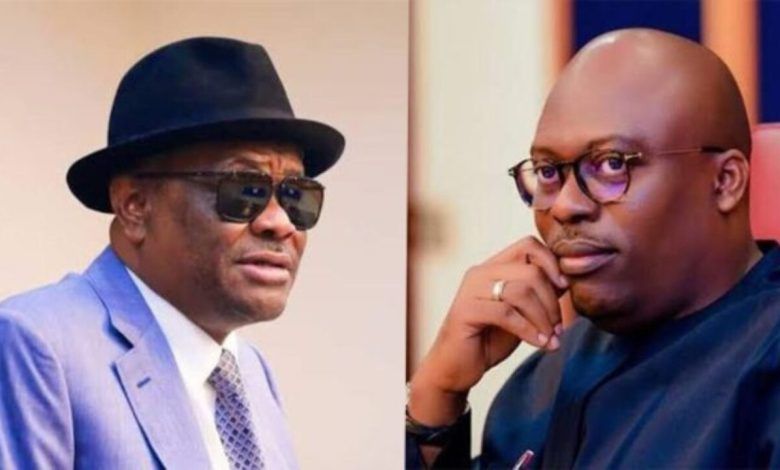
In a fresh move to calm Rivers State’s lingering political unrest, suspended Governor Siminalayi Fubara has held a private meeting with his political mentor and estranged ally, Nyesom Wike, at the latter’s Abuja residence.
The meeting, held earlier this week, comes amid growing expectations that President Bola Tinubu might soon lift the state of emergency imposed on Rivers and restore Fubara to office. Although no official statement has been released detailing the outcome of the talks, insiders suggest the dialogue centered on reconciliation and political stability.
Mounting Pressure on Tinubu
Fubara’s supporters—particularly the group known as The Simplified Family—had anticipated that President Tinubu would announce the end of the emergency rule during his Democracy Day speech at the National Assembly. That moment never came. Instead, the President forwarded a formal letter to the Senate requesting confirmation of appointments made by the state’s emergency administrator, Vice Admiral (Rtd.) Ibok-Ete Ibas.
The development frustrated backers of the suspended governor, including Senator Seriake Dickson, who criticized the President’s silence on the Rivers crisis during his national address. Dickson described the continued emergency rule as “undemocratic” and likened the interim administration to a military regime.
Lawmakers Push Back
Dickson’s remarks have drawn sharp criticism from Rivers State’s National Assembly caucus. Led by Rep. Kingsley Chinda, the group dismissed the senator’s claims and questioned his authority to comment on the state’s internal affairs.
“Rivers is not under military rule. The current administrator is a retired naval officer, just like Senator Dickson is a retired police corporal,” Chinda said during a press briefing. He argued that retired officers are civilians and governed by democratic laws, insisting that the emergency rule was a constitutional necessity to curb escalating political instability.
The lawmakers also accused Dickson of influencing Fubara with divisive rhetoric that led to his political missteps and eventual suspension. They have called on the Senate Committee on Ethics to investigate what they termed Dickson’s “un-parliamentary” conduct.
Political Reconciliation Still Elusive
Despite Fubara’s outreach to Wike and President Tinubu, political reconciliation in Rivers remains stalled. Key stakeholders, including pro-Wike legislators and elder statesmen instrumental in Fubara’s 2023 election—OCJ Okocha, Sargent Awuse, and Ferdinand Alabraba—have reportedly been sidelined from the process.
“Fubara is yet to meet with many of those who shaped his political journey,” a legislative source told The Nation. “Without engaging them or the state assembly, the crisis is far from over.”
Former Emohua LGA chairman, Dr. Chidi Lloyd, echoed the sentiment, saying, “There’s nothing to celebrate about a return to office without first resolving the fundamental issues.”
Dickson Under Fire for Hypocrisy
Senator Dickson’s critics also point to his past as governor of Bayelsa State, accusing him of similar undemocratic actions—such as refusing to inaugurate opposition lawmakers and allegedly intimidating judiciary members.
Bayelsa State Assembly member Timi Agala-Omubo accused the senator of double standards. “He’s quick to condemn now, but his own record as governor shows a pattern of silencing opposition voices,” he wrote on social media.
What Next for Rivers?
With no clear resolution in sight, concerns persist about governance paralysis in Rivers State. The national legislature is yet to pass the state budget, and the suspended governor’s limited engagements suggest a return to office without full political buy-in could worsen tensions.
A former leader of the Ijaw Youth Council cautioned that any return to power must be preceded by honest reconciliation efforts. “If Fubara walks back into office without mending fences, the cycle of conflict will only continue,” he warned.
As the state grapples with leadership uncertainty, all eyes remain on Abuja—awaiting the next move that could either restore peace or deepen the crisis in one of Nigeria’s most politically volatile regions.