Japanese and South Korean Leaders Commit to Strengthening Security and Economic Cooperation Ahead of U.S. Summit

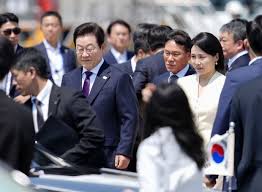
During his first official trip to Japan since assuming office in June, South Korean President Lee Jae Myung met with Japanese Prime Minister Shigeru Ishiba on Saturday at the premier’s residence in Tokyo. The two leaders discussed enhancing bilateral relations between their neighboring East Asian countries, focusing on closer security collaboration with the United States under a trilateral agreement established by their predecessors.
“As the strategic environment surrounding both our countries grows increasingly severe, the importance of our relations, as well as trilateral cooperation with the United States, continues to grow,” Ishiba said in a joint statement issued after the meeting.
Both leaders agreed to reinstate shuttle diplomacy, broaden exchanges such as working holiday programs, and intensify cooperation in areas including defense, economic security, and artificial intelligence. They also committed to stronger coordination to counter North Korea’s nuclear and missile threats.
The unexpected election victory of the liberal Lee, which followed the impeachment of conservative President Yoon Suk Yeol over his declaration of martial law, had sparked concerns in Tokyo about potential deterioration in relations with Seoul.
Lee has openly criticized previous attempts to mend ties strained by lingering historical grievances related to Japan’s colonial rule over the Korean Peninsula from 1910 to 1945. Last week, South Korea’s government expressed “deep disappointment and regret” following a visit by Japanese officials to a Tokyo shrine dedicated to Japan’s war dead—seen by many Koreans as a symbol of wartime aggression.
Despite these tensions, Lee reaffirmed his commitment to improving ties with Japan during the Tokyo meeting, echoing his stance when he first met Ishiba at the Group of Seven summit in Canada this June.
Though their relationship remains complex, Japan and South Korea, both U.S. allies, heavily depend on Washington to counterbalance China’s expanding influence in the region. Together, they host approximately 80,000 U.S. troops, along with numerous American warships and military aircraft.
“We agreed that unwavering cooperation between South Korea, the U.S., and Japan is paramount in the rapidly changing international situation, and decided to create a virtuous cycle in which the development of South Korea-Japan relations leads to stronger cooperation,” Lee said alongside Ishiba.
Ahead of his planned meeting with U.S. President Donald Trump on Monday in Washington, Lee is expected to discuss pressing security issues including China, North Korea, and South Korea’s financial contributions toward hosting U.S. forces—a matter Trump has repeatedly urged Seoul to increase.
On trade matters, Japan and South Korea found common ground by agreeing to impose 15% tariffs on U.S. imports of their products, following Trump’s threat of higher tariffs.