Nigeria’s climate commitments are facing renewed scrutiny, with experts and climate advocates calling for stronger gender-responsive policies, greater accountability and urgent action to ensure international pledges translate into tangible results for communities.
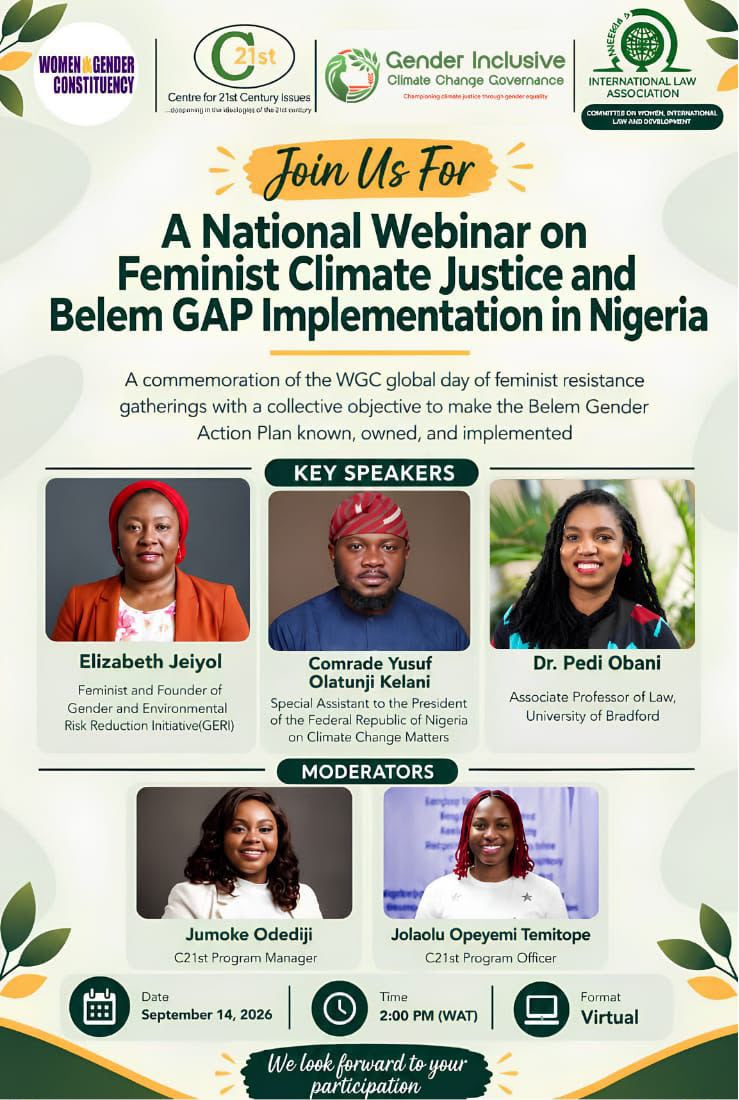
The call was made during a webinar organised by the Centre for 21st Century Issues, C21st, which examined feminist climate justice and Nigeria’s implementation of the Belém Gender Action Plan, a framework developed under the United Nations climate process to advance gender equality and strengthen women’s participation in climate action.
The discussion focused on how Nigeria can move the objectives of the plan from international commitments to practical interventions — expanding women’s participation in climate decision-making, improving access to climate finance and ensuring policies reflect the realities of women and girls, particularly those living in rural and climate-vulnerable communities.
Participants also called for stronger collaboration among government institutions, civil society organisations and grassroots groups, alongside targeted efforts to equip women and young people with the skills and resources needed to play a greater role in developing climate solutions.
For climate advocates, the test of Nigeria’s international commitments is not how prominently they feature in policy documents, but whether they deliver measurable change in communities.
They want climate action to extend beyond federal institutions to states, local governments and grassroots communities, where women are often among those most exposed to the consequences of a changing climate.
The Special Assistant to the President on Climate Change Matters, Yusuf Olatunji Kelani, drew attention to the unequal impact of climate change, particularly on women in coastal and farming communities and households struggling with access to water, food and energy.
The discussion underscored that climate change has moved far beyond the boundaries of environmental policy. Its effects are increasingly felt in livelihoods, household incomes, food security, public health, social justice and human rights — making women’s participation in climate governance an essential part of the response.
Speakers also challenged the traditional portrayal of women solely as victims of climate change, stressing their potential as farmers, entrepreneurs, scientists, innovators, policymakers and community leaders capable of driving effective solutions.
From renewable energy and clean cooking to sustainable agriculture, recycling, waste management, ecosystem restoration and green businesses, participants identified opportunities to invest in women while strengthening Nigeria’s overall climate resilience.
But they stressed that investment must be accompanied by accountability.
Advocates want greater transparency over how climate commitments are implemented, how funds are distributed, who benefits from climate interventions and whether women and grassroots communities have a genuine voice in setting climate priorities.
They are also calling for measurable targets, dedicated financing mechanisms and effective monitoring systems capable of tracking implementation from government institutions down to communities most vulnerable to climate risks.
Associate Professor of Law at the University of Bradford, Dr. Padi Obani, traced the development of gender-responsive climate governance, noting that the Belém Gender Action Plan builds on earlier international initiatives, including the Lima Work Programme on Gender established in 2014 and the first Gender Action Plan adopted at COP23 in 2017.
The latest framework places greater emphasis on implementation across key areas including capacity building, knowledge sharing, gender balance and women’s leadership, policy coherence, gender-responsive implementation and financing, as well as monitoring and reporting.
For Nigeria, participants say the challenge is ensuring that these principles do not remain confined to federal institutions or major cities.
Obani stressed the need to bring state and local governments, community-based organisations, traditional institutions, grassroots groups and women-led organisations into climate governance, particularly in communities facing the most immediate climate threats.
She also called for deliberate investment in young people, arguing that equipping the next generation with the knowledge and skills to understand and address climate challenges will be crucial to sustaining climate action.
Environmental and feminist geographer Elizabeth Jeiyol further highlighted the gendered consequences of climate change, particularly for women in rural and low-income communities.
Limited access to land, finance, healthcare, technology, information and decision-making platforms can deepen existing inequalities when climate shocks strike.
Water shortages, food insecurity, flooding, extreme heat, displacement and disrupted livelihoods can also increase women’s unpaid domestic and care responsibilities, while creating additional risks for women and girls, including exposure to gender-based violence.
Participants therefore called for a broader understanding of climate vulnerability — one that looks beyond exposure to environmental hazards and examines who bears the greatest social and economic cost when access to water, food, livelihoods, education and essential services is disrupted.
Climate finance was another major focus of the discussion.
While Nigeria continues to develop its climate finance architecture, including efforts around the Climate Change Fund, participants warned that funding must reach the communities where climate pressures are most severe.
They called for greater access to financing for women-led organisations, community groups and grassroots initiatives working directly with vulnerable populations.
At the centre of the conversation was a demand for accountability.
For the advocates, Nigeria’s climate ambitions should ultimately be judged not by the number of international commitments it makes, but by the measurable difference those commitments make in the lives of people confronting climate pressures every day.
As implementation of the Belém Gender Action Plan advances within the global climate process, the challenge for Nigeria is to bridge the gap between international promises and local realities through stronger policies, transparent financing, measurable targets and inclusive decision-making.
For women and girls living on the front lines of climate change, the real measure of climate justice will not be found in policy documents, but in what changes in their homes, farms and communities.