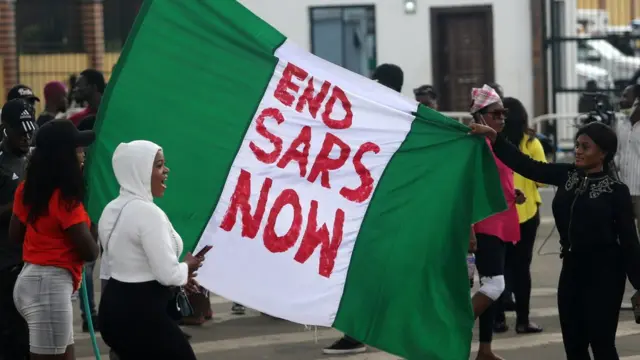
Five years after the historic #EndSARS protests, Nigerians say the injustices that sparked the 2020 demonstrations remain largely unresolved.
The events of October 20, 2025 underscored this perception when Opeyemi Adamolekun, Executive Director of Enough is Enough (EiE) Nigeria, was harassed by security operatives while laying flowers at the Lekki Toll Gate in honour of those killed during the protests. Only one other citizen, diaspora Nigerian Nanre Nafziger, was present at the memorial.
The solemn commemoration again cast a spotlight on unresolved cases of extrajudicial killings, unlawful detentions, and the government’s failure to deliver comprehensive police reform—issues that drove the protests five years ago.
The memories remain sharp: For those who disappeared in SARS custody. For those still awaiting justice behind bars. For families who never received answers. For the protester whose final words were, “Nigeria will not end me.”
A Movement That Shaped a Generation
In October 2020, young Nigerians mobilised nationwide in an unprecedented wave of protests against police brutality. With volunteer-led food drives, medical teams, helplines, legal aid, and tech-enabled tracking systems, the movement created a distributed network of support. Millions of social media posts amplified their demands, while global demonstrations expressed solidarity.
Today, the impact of that moment lingers.
Some protesters are still advocating. Some are in exile.
Some have entered politics—and won.
Some are in therapy.
But all were transformed by a moment that redefined their relationship with power and citizenship.
A Nation Still Reckoning With Trauma
The #EndSARS demonstrations were met with state-sanctioned violence: hired thugs, shootings, arrests, bank account freezes, raids, disinformation campaigns, and a clampdown on media coverage. Victims flooded hospitals, while families dealt with life-altering injuries caused by gunshots. Citizens were treated as enemies for demanding an end to extrajudicial killings.
The protests were never only about the Special Anti-Robbery Squad. They were about the deeper issues SARS symbolised—impunity, corruption, poverty weaponisation, and the systemic devaluation of young lives.
Judicial panels were established across states, and victims gave testimonies. Yet, five years later, many of the panel reports remain unimplemented, buried in bureaucracy.
THE UNFINISHED AGENDA OF #ENDSARS
- Police Reform
Activists insist that while SARS was renamed, its abusive practices persist. Extortion, torture, and arbitrary arrest continue under different units.
They call on the Federal Ministry of Justice and the Ministry of Police Affairs to immediately finalise the gazetting of revised Police Regulations under the Police Act 2020—an essential step toward institutional accountability.
- Accountability for State Violence
The Lekki Toll Gate shooting on October 20, 2020 remains a watershed moment.
From Tiv Valley to Asaba, Odi to Zaria, Oyigbo to Lekki, Nigeria’s long history of state violence continues to haunt political life.
An SBM Intelligence investigation—later presented before the ECOWAS Court—uncovered patterns of coordinated violence, cover-ups, and intimidation during #EndSARS.
- Justice for Victims
The Lagos Judicial Panel found that both the Nigerian Army and the police carried out a “massacre” and attempted to conceal it. It recommended prosecutions and compensation.
However, the federal government dismissed the panel’s findings as “fake news,” and the Lagos State White Paper further downplayed the incident, referring to it merely as a “shooting.”
In July 2024, the ECOWAS Court ruled that the Nigerian government violated human rights through its actions and ordered compensation for victims.
To date, activists note that there has been no credible move toward compliance.
- Release of Detained Protesters
Several #EndSARS detainees, including Dare Williams and Rasheed Wasiu—held in Kirikiri Correctional Centre—have reportedly never been tried. Advocates demand their immediate release and a review of similar cases nationwide.
A Lingering Wound
The failure to provide justice for the Lekki victims has left a deep national scar. Five years on, activists warn that without accountability, the trauma will continue to poison public trust and embolden further abuses.
As October passes each year, the memory of Lekki resurfaces—not as a historical footnote but as a constant reminder of the unresolved struggle for justice in Nigeria.
A detailed timeline of the #EndSARS movement is available at eieng.co/endsars.