The billionaire says the $16bn project will be completed by 2030 despite a court order restricting construction over a land dispute…..
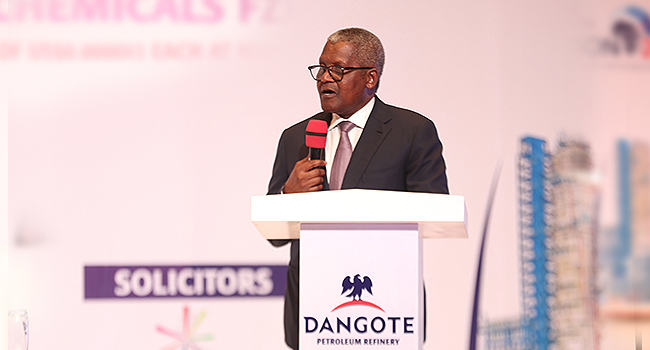
Nigerian billionaire and President of the Dangote Group, Aliko Dangote, has accused local oil marketers and international oil companies of being behind protests over land designated for his proposed $16bn refinery in Lamu, Kenya.
Dangote made the allegation as he and Kenyan President William Ruto officially launched the refinery project on Wednesday, despite an ongoing legal dispute over the land on which construction is planned.
Speaking during an interview, Dangote dismissed concerns raised by some residents over compensation for land acquired for the project and rejected claims that his company had taken more land than was allocated.
He said the company was only using the portion of land granted to it by the Kenyan Government.
“They said some people are demonstrating; demonstrating about what? Have you ever seen people demonstrating against themselves in terms of development?” he asked.
Dangote described the protests as “games played by local marketers and international players”, while maintaining that opposition to the project would not prevent its completion.
The proposed refinery is expected to process 700,000 barrels of crude oil per day when fully operational in 2030, making it one of the largest refining projects on the African continent.
The groundbreaking ceremony attracted several African leaders, including the presidents of Uganda, Ethiopia, Togo and Benin.
According to Reuters, Dangote has also offered regional governments a combined 30 per cent stake in the proposed refinery.
The businessman described the Lamu project as his biggest proposed investment outside Nigeria and said it would replicate the experience of his 700,000-barrel-per-day refinery in Lagos.
“Lekki proved that it can be done, Lamu must prove that it can be repeated,” he said.
The project, however, faces legal and environmental challenges from sections of the local community.
The Save Lamu campaign group has raised concerns about the potential environmental consequences of the development. Its co-founder, Walid Ali, told the BBC that residents wanted access to the environmental impact assessment and details of measures proposed to mitigate the project’s effects.
The dispute has also moved to the courts, with 133 Lamu residents seeking judicial intervention to halt construction on the disputed land.
Following the legal action, the Kenyan High Court restricted activities including excavation and construction pending a further hearing scheduled for October 14.
Dangote maintained that the legal challenge would not derail the project, saying the refinery was expected to provide substantial employment opportunities for the local population.
He said approximately 60,000 jobs could be created at the peak of construction, with communities around the project expected to benefit from the economic activity it generates.
The planned development will also feature a 1,000-megawatt power plant, which is expected to provide electricity for the refinery and support other industries that could emerge around the facility.
If completed as planned, the project would become East Africa’s largest refinery and Kenya’s biggest infrastructure development since independence, surpassing the $5.1bn Standard Gauge Railway project.