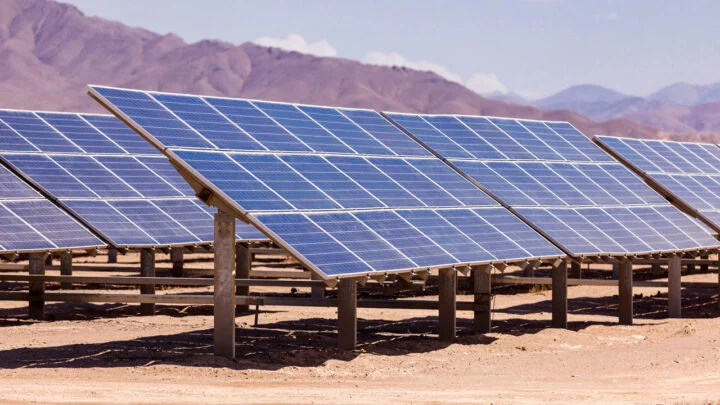
Shipments hit 123,787 metric tons in April, driven by Africa’s expanding solar adoption and shifting global trade flows…..
China’s exports of solar cells and panels to Africa surged sharply in April 2026, rising 83% year-on-year as global demand for renewable energy continued to accelerate.
According to customs data released by Chinese authorities and reported by Reuters, shipments to African countries reached 123,787 metric tons in April, up from 67,552 metric tons in the same period last year.
However, the April figure represents a decline from March’s peak of 209,474 metric tons, reflecting a cooling in demand after a temporary surge in pre-policy buying.
The March spike was largely driven by global importers rushing to secure shipments ahead of China’s decision to end its solar export tax refund policy effective April 1, a move expected to increase export prices and reshape trade flows.
Despite the monthly slowdown, the broader trend shows sustained growth in China’s solar exports, with Africa emerging as one of the fastest-growing destinations for photovoltaic imports amid rising energy access challenges and renewable energy investments across the continent.
The data also showed that Africa was not the only region experiencing strong demand. Exports to Southeast Asia rose 75% year-on-year to 170,733 metric tons in April, although this was significantly lower than March’s unusually high volumes of 336,891 metric tons.
Globally, solar exports increased by about 60% year-on-year on a per-unit basis, underscoring the continued expansion of renewable energy deployment across emerging and developed markets alike.
Trade flows further revealed shifting regional dynamics. Europe and Asia remained dominant import destinations, while Africa’s share continued to grow steadily.
The Netherlands remained the largest single importer, receiving 177,391 metric tons in April and serving as a key redistribution hub into wider European markets. Shipments to the country were valued at approximately $380.8 million.
In Africa, South Africa stood out as one of the largest buyers, with imports rising 81.4% year-on-year, reflecting growing utility-scale solar deployment and private sector investment in renewable infrastructure.
The Democratic Republic of the Congo also recorded a dramatic 482% increase in imports, reaching 17,953 metric tons, signalling rapid expansion in solar adoption in emerging African energy markets.
Meanwhile, the Philippines saw imports fall sharply from March highs as pre-tariff stockpiling eased, highlighting how policy shifts in China are increasingly influencing global solar trade patterns.
Energy analysts say the surge in African imports reflects the continent’s growing importance in the global renewable energy transition, driven by rising electricity demand, off-grid electrification efforts, and large-scale solar projects.
Recent data from energy think tank Ember showed that Africa’s total solar imports climbed 60% year-on-year in 2025 to 15,032 MW, with Nigeria ranking as the continent’s second-largest importer.
Nigeria’s position has been further strengthened by ongoing energy shortages and increased adoption of distributed solar systems for homes, businesses, and rural electrification.
However, the Federal Government has also signaled plans to restrict solar panel imports in favour of boosting local manufacturing capacity, a move that could reshape future import trends across the region.