Bolsonaro Denies Coup Plot in Historic Testimony Before Brazil’s Supreme Court

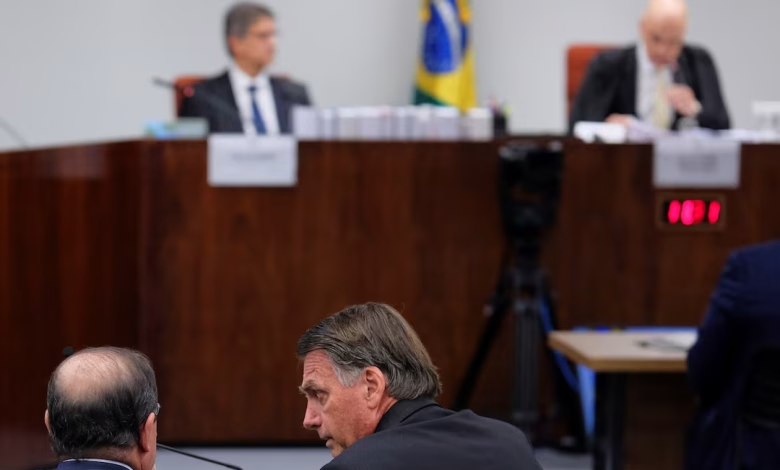
Brazil’s former president Jair Bolsonaro appeared before the Supreme Court for the first time on Tuesday, forcefully denying allegations that he orchestrated a coup attempt to overturn the results of the 2022 presidential election, which he lost to Luiz Inácio Lula da Silva.
The 70-year-old far-right leader and seven of his close allies are standing trial in what has been described as a landmark case—the first in Brazil’s democratic history involving charges of an attempted coup. If convicted, Bolsonaro could face up to 40 years in prison.
Testifying before Supreme Court Justice Alexandre de Moraes—a fierce critic and central figure in the legal proceedings—Bolsonaro denied all charges.
“There was never any discussion of a coup,” Bolsonaro said. “A coup is an abomination. Brazil could never go through such an experience, and during my government, it was never even a possibility.”
The former army captain, who governed from 2019 to 2022, has long been accused of undermining Brazil’s democratic institutions, especially its judiciary. Critics have pointed to his repeated challenges to the electoral system and admiration for the country’s former military dictatorship.
Al Jazeera’s Monica Yanakiew reported from Rio de Janeiro that Bolsonaro’s tone during the hearing echoed the rhetoric of a political campaign rather than a legal defense.
The charges stem from what prosecutors describe as a coordinated, multi-stage plan by Bolsonaro and his inner circle to annul Lula’s victory and cling to power. According to court documents, the scheme failed largely due to the military’s refusal to support it.
The investigation took a dramatic turn Monday when Bolsonaro’s former aide-de-camp, Lt. Col. Mauro Cid—now a cooperating witness—told investigators that Bolsonaro had reviewed and edited a draft decree that would have declared a state of emergency.
The document allegedly called for the annulment of the election results and the arrest of prominent figures, including Justice de Moraes.
Cid also testified that funds to support the coup attempt were delivered in a wine crate by Bolsonaro’s former running mate and defense minister, Walter Braga Netto.
According to investigators, the money was intended to finance a paramilitary operation that would have targeted President Lula, Vice President Geraldo Alckmin, and Justice de Moraes.
Bolsonaro’s legal team has dismissed the accusations as politically motivated and based on hearsay, though the weight of testimony and evidence continues to mount.
The trial represents a critical test for Brazil’s democratic institutions in a country still reckoning with its authoritarian past. As the proceedings unfold, the nation watches closely, aware that the outcome could redefine the boundaries of political accountability in Latin America’s largest democracy.