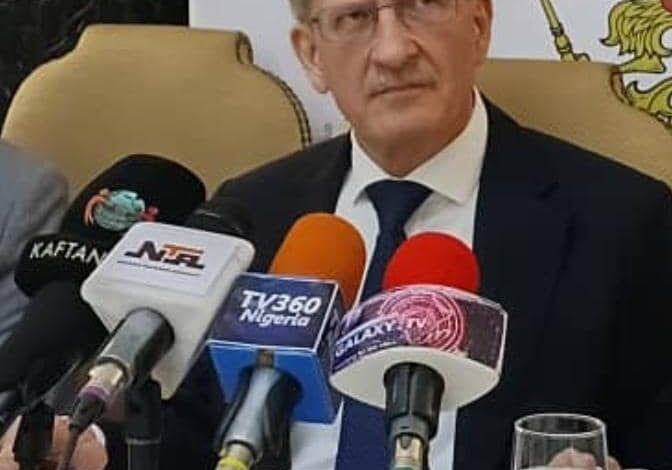
The Russian Ambassador to Nigeria, Andrey Podelyshev, has urged the international community to reconsider its perspective on the war in Ukraine, asserting that any meaningful resolution must address the “root causes” of the conflict rather than focusing solely on its symptoms.
During a press briefing in Abuja, Ambassador Podelyshev refuted the Western narrative that Russia’s actions in February 2022 constituted the onset of an unprovoked war. Instead, he provided a detailed account of what he termed the true origins of the crisis, which he traced back to the political upheaval in Kyiv in 2014.
“According to the narrative promoted by Western countries, the conflict is perceived to have begun in February 2022, when Russia supposedly launched an unprovoked and aggressive war against peaceful Ukraine,” he stated.
He emphasized that this framework typically overlooks the significant events that led up to February 2022, which unfolded over the previous eight years beginning in 2014.
Podelyshev characterized the 2014 ousting of former President Viktor Yanukovych as an “unconstitutional coup d’état,” claiming that Western nations not only supported the opposition but also played a role in Ukraine’s descent into civil conflict.
“The President of Ukraine had to flee the country to prevent a bloody scenario. The guarantors, composed of Germany, France, and Poland, chose to remain silent, which effectively encouraged the opposition to take further unconstitutional actions,” the ambassador asserted.”
He accused Ukraine’s post-2014 leadership of pursuing a deliberate campaign of marginalisation and discrimination against Russian-speaking citizens, outlawing the Russian language and dismantling cultural heritage.
“Imagine a situation where the Hausa, Fulani, or Yoruba languages were banned in Nigeria. In fact, more than half of the Ukrainian population spoke Russian.”
He added that revered Russian cultural and wartime symbols were torn down and replaced with monuments to controversial nationalist figures like Stepan Bandera and Roman Shukhevych, whom he described as “war criminals” who “personally took part in the executions of tens of thousands of civilians.”
“Instead of honouring the soldier-liberators of Ukraine during the Great Patriotic War of 1941–1945, war criminals such as Stepan Bandera and Roman Shukhevych were declared national heroes of Ukraine,” the envoy noted.
He portrayed the Minsk Agreements, signed between 2014 and 2015, as a missed opportunity for peace due to Ukraine’s alleged refusal to implement them in good faith.