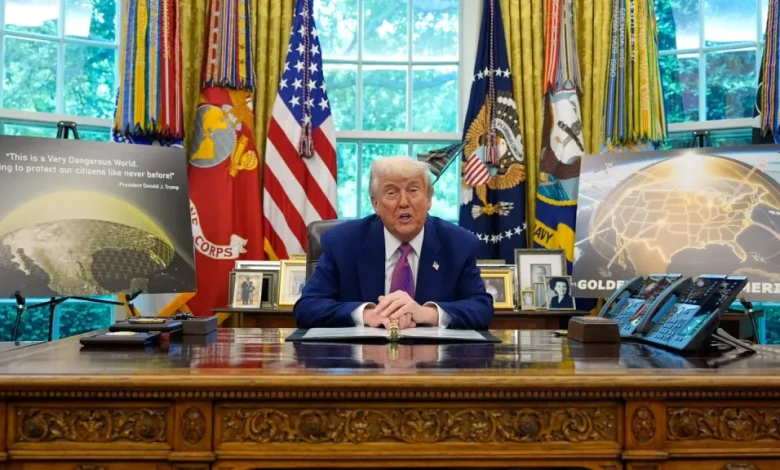
In a sweeping bid to reshape America’s strategic defense landscape, U.S. President Donald Trump has unveiled the design for the $175 billion Golden Dome missile defense system, a satellite-powered shield designed to intercept long-range threats from adversaries such as China and Russia.
At a White House press conference on Tuesday, Trump announced the appointment of U.S. Space Force General Michael Guetlein as the program’s lead commander, calling the initiative a “next-generation solution to 21st-century threats.”
“This will be the shield that protects our homeland,” Trump declared. “This is Star Wars, but real — and it will work.”
The Golden Dome is envisioned as a space-based missile detection and interception system — a constellation of potentially hundreds of satellites capable of identifying and neutralizing incoming projectiles before they reach American or allied soil.
The project draws conceptual inspiration from Ronald Reagan’s 1980s Strategic Defense Initiative, famously dubbed “Star Wars.” But unlike its Cold War predecessor, Trump emphasized that today’s technological advancements make such an effort feasible.
“Reagan dreamed it. We’re building it,” he said.
Trump stated the system is expected to be fully operational by January 2029, coinciding with what would be the end of his second presidential term, should he return to office.
In a notable geopolitical development, Canada has expressed interest in participating in the Golden Dome initiative. A statement from Canadian Prime Minister Mark Carney’s office confirmed ongoing high-level talks with U.S. counterparts.
“These discussions naturally include strengthening NORAD and related initiatives such as the Golden Dome,” the statement read.
This potential collaboration could signal a revitalization of continental defense alliances amid growing international tensions.
Though the White House placed the program’s cost at $175 billion, defense analysts are cautioning that the actual expense may soar much higher. A recent Congressional Budget Office (CBO) estimate projects costs could reach $831 billion over two decades.
“The new datapoint is the $175 billion,” said Tom Karako, senior fellow at the Center for Strategic and International Studies (CSIS). “But the real question is: over how many years will it unfold?”
Karako also emphasized the role of Silicon Valley’s software, AI, and satellite expertise, suggesting that a hybrid approach — blending government infrastructure with private-sector innovation — may be key to execution.
The Golden Dome is emerging as a defining pillar of Trump’s defense agenda, likely to dominate national security discourse leading into the 2026 midterms and the 2028 presidential election.
However, the project faces significant challenges: Budgetary pushback from Congress, Concerns among NATO allies about militarizing space, Escalation fears among adversaries like Russia and China
Still, Trump loyalists argue that in a world of hypersonic missiles and cyber-augmented warfare, traditional defense paradigms are outdated.
“This isn’t a luxury,” said a senior Pentagon official. “It’s a necessity. This is 21st-century deterrence.”
The Golden Dome represents more than just a missile shield. It’s a geopolitical statement, a technological frontier, and potentially the most ambitious U.S. defense initiative since the Cold War.