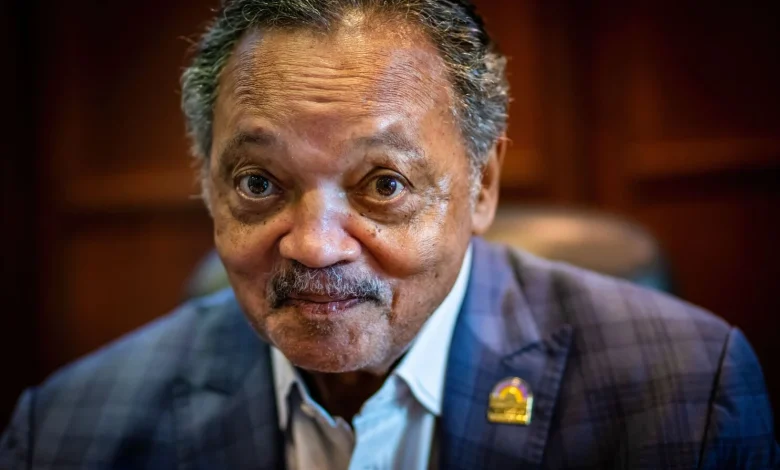
Veteran American civil rights leader Jesse Jackson has died at the age of 84, his family confirmed Tuesday, bringing to a close a remarkable career that shaped modern American politics and advanced the global fight for racial justice.
“His unwavering belief in justice, equality, and love uplifted millions,” his family said in a statement. “We ask you to honor his memory by continuing the fight for the values he lived by. Our father was a servant leader — not only to our family, but to the oppressed, the voiceless, and the overlooked around the world. We shared him with the world, and in return, the world became part of our extended family.”
A Towering Figure in Civil Rights
A close ally of Martin Luther King Jr. during the 1960s, Jackson rose as one of the movement’s most powerful voices. A gifted orator, preacher, and activist, he dedicated more than six decades to expanding opportunities for African Americans and advocating for economic and social justice.
Jackson witnessed history firsthand, standing in Memphis in 1968 when King was assassinated. Decades later, he openly wept during Barack Obama’s landmark 2008 presidential victory, a symbolic moment reflecting the progress of the civil rights struggle he helped lead.
In 2021, he stood with the family of George Floyd following the conviction of the former police officer responsible for Floyd’s death, calling the verdict a moment of “relief, but not a time for celebration.”
“My constituency is the desperate, the damned, the disinherited, the disrespected, and the despised,” Jackson declared at the 1984 Democratic National Convention, encapsulating the moral urgency that defined his activism.
From the Pulpit to the Presidential Stage
Jackson gained prominence through leadership in King’s Southern Christian Leadership Conference, before founding Operation PUSH in 1971 and the National Rainbow Coalition in 1981, which merged in 1996 to create a powerful platform for social and political advocacy.
His presidential campaigns broke new ground for African Americans in national politics. In 1984, he finished third in the Democratic primaries behind Walter Mondale and Gary Hart, becoming the most successful Black presidential candidate in U.S. history at the time.
Four years later, he finished second to nominee Michael Dukakis, delivering a memorable convention speech urging Americans to seek “common ground.”
Jackson was a fierce critic of what he called the “reverse Robin Hood” policies of President Ronald Reagan, which he argued favored the wealthy at the expense of the poor. Though he never won the presidency, his campaigns broadened the Democratic Party coalition and cemented minority rights and economic justice as central issues.
Global Advocate and Controversial Figure
Jackson’s activism extended well beyond the U.S. He championed the fight against apartheid in South Africa and served as a special envoy for Africa under Bill Clinton, negotiating international prisoner releases in countries including Syria, Iraq, and Serbia.
Yet his career was not without controversy. In 1984, he sparked criticism for calling New York “Hymietown,” a derogatory term for Jews, and he faced scrutiny when his son, former Congressman Jesse Jackson Jr., served prison time for misappropriating campaign funds.
Humble Origins, Enduring Legacy
Born Jesse Louis Burns on October 8, 1941, in Greenville, South Carolina, to a teenage mother, Jackson later adopted the surname of his stepfather, Charles Jackson. “I was not born with a silver spoon in my mouth. I had a shovel programmed for my hands,” he once reflected.
A gifted student-athlete, he earned a football scholarship to the University of Illinois before transferring to North Carolina Agricultural and Technical College, where he graduated with a degree in sociology.
Jackson’s first sit-in came in 1960 in Greenville, and he participated in the Selma-to-Montgomery marches in 1965, milestones that cemented his lifelong dedication to activism.
In 2017, Jackson disclosed he had been diagnosed with Parkinson’s disease, gradually reducing public appearances. Yet even in declining health, he remained a moral voice, speaking on race, justice, and equality up until recent years.