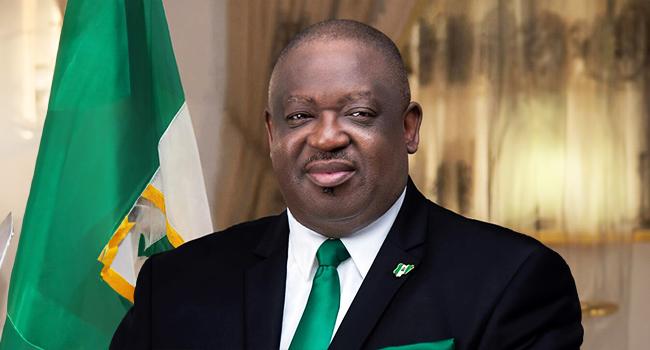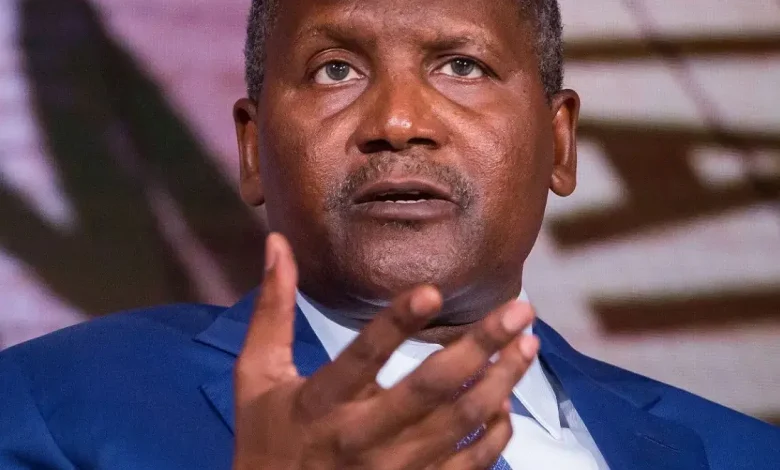
President and Chief Executive of Dangote Industries Limited Aliko Dangote, has called on Africa’s business elite, investors, and entrepreneurs to prioritize investing within the continent, saying that true progress lies in African-led solutions to its own development challenges.
Speaking in Lagos while hosting participants from the Global CEO Africa Programme, a partnership between Lagos Business School and Strathmore Business School in Nairobi, Dangote emphasized that Africa’s transformation will only come from bold, strategic investments made by Africans for Africans.
The CEOs, drawn from six countries, had just concluded a tour of the Dangote Petroleum Refinery & Petrochemicals complex in Ibeju-Lekki, Lagos widely regarded as the largest single-train refinery in the world.
Dangote told the visiting executives that Africa is rich in both human talent and natural resources, but has long suffered from underinvestment by its own citizens. He stressed the importance of directing African capital into local industries rather than foreign assets.
“We must stop taking our money out of Africa. That capital should be used to develop our nations. I don’t move my money abroad because if we don’t have confidence in our own economies, why should foreign investors?” he stated.
He described the multi-billion-dollar refinery as a symbol of what’s possible when Africans commit to long-term, visionary projects despite scepticism and hurdles.
“When we began this refinery project, people doubted it was even feasible. But here we are today. Now, we believe we can do even more. Our next target is to make our fertiliser company the largest in the world within 40 months,” Dangote said.
He encouraged the CEOs to embrace ambition and resilience, saying challenges are inevitable but surmountable.
“There will always be obstacles but life without challenges isn’t exciting. The key is to face those you can conquer,” he said. “Think big, act bold. Playing small limits growth.”
Dangote lamented the disconnect among African economies, citing an example where importing goods from Spain was cheaper than moving cement clinker from Nigeria to Ghana. He emphasized the need for better regional integration, policy stability, and infrastructure development.
He also drew comparisons with countries like Dubai and Singapore, noting that both were once at similar economic levels with some African nations in the 1970s but have leapfrogged ahead through deliberate leadership and private sector commitment.
“Many African nations may have political independence, but they are still economically dependent. That needs to change and only Africans can make it happen.”
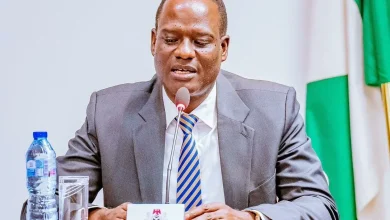
The Lagos Business School delegation was led by Professor Olayinka David-West, Dean of the institution. She said the visit underscored the school’s mission to nurture leaders equipped to solve Africa’s toughest challenges. She praised Dangote as a visionary whose work extends far beyond business.
“This refinery is more than an industrial project it is a catalyst for regional integration and a practical tool for enabling frameworks like AfCFTA,” she said.
Executive Dean of Strathmore Business School Caesar Mwangi, echoed these sentiments, saying that African business leaders must take inspiration from projects like the Dangote refinery to build inclusive growth at scale.
“The biggest lesson here is that Africans can and must lead the development of Africa. This refinery proves that bold action is the path forward.”
Patrick Akinwuntan, Academic Director of the Global CEO Africa Programme, said the initiative aims to shape a new generation of leaders who see Africa not as fragmented countries, but as one unified market filled with opportunity. Participants in the programme complete modules in Kenya, Nigeria, and the United States.
Dr Rabiu Olowo, CEO of Nigeria’s Financial Reporting Council and a participant in the programme, said the experience reignited a sense of duty among participants to think beyond business as usual.
Other high-profile attendees included Segun Aina, a global banking expert; Nancy Njau, Managing Director of Family Bank (Nairobi); Emmanuel Wakili, CFO for Ecobank in Cameroon and the CEMAC region; and Ibukun Oyedeji, former President of the CFA Society Nigeria.