Stakeholders say printing higher-value naira bills would worsen inflation, derail cashless policy, and benefit only the wealthy….
The Organised Private Sector (OPS) and the Nigeria Labour Congress (NLC) have strongly opposed proposals calling for the introduction of ₦10,000 and ₦20,000 naira notes, warning that such a move would worsen inflation, encourage hoarding, and reverse progress made under Nigeria’s cashless policy.
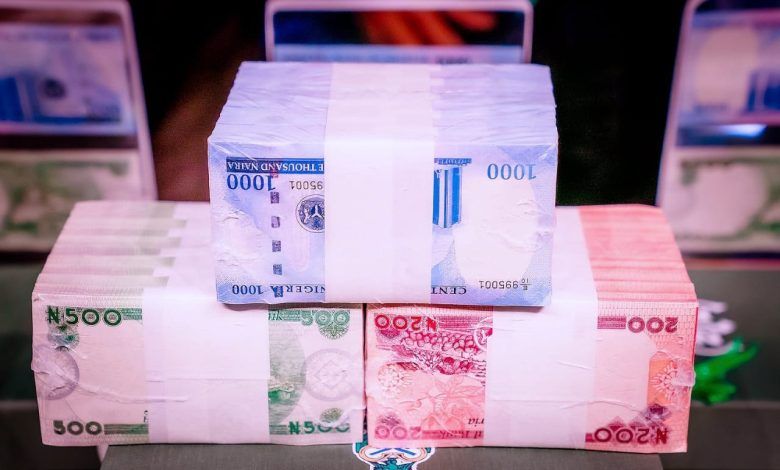
Their reactions followed a recent report by Quartus Economics, which urged the Central Bank of Nigeria (CBN) to issue higher-value notes to “restore the naira’s portability” and cut the cost of cash transactions. The report, titled “Is Africa’s Eagle Stuck or Soaring Back to Life?”, argued that Nigeria’s ₦1,000 note currently the highest denomination has become “practically obsolete in terms of purchasing power.”
However, business and labour leaders described the idea as ill-timed, elitist, and economically risky.
Private Sector Rejects Move
The National Vice President of the Nigerian Association of Small-Scale Industrialists (NASSI), Segun Kuti-George, said the plan would mainly benefit the rich and contradict the government’s push toward a digital economy.
“Such a policy could worsen inflationary pressures,” Kuti-George warned. “Even considering such denominations reflects deep inflationary concerns, and implementing them will only escalate the problem. If anything, a ₦2,000 note might be sufficient, but anything beyond that makes no economic sense.”
He added that higher-value notes would make it easier for the wealthy to stockpile illicit cash, saying the proposal “favours corruption more than commerce.”
“At a time when Nigeria is pushing for reduced cash transactions and digital payments, this idea takes us backwards,” he said.
Kuti-George questioned the practicality of issuing large notes in an economy where the minimum wage is ₦70,000.
“If minimum wage is ₦70,000, what’s the logic of paying workers with just three ₦20,000 notes and one ₦10,000 note? It’s meaningless,” he said.
SME Leaders Call Proposal ‘Bogus and Dangerous’
Also rejecting the idea, the Director-General of the Nigerian Association of Small and Medium Enterprises (NASME), Eke Ubiji, described it as “a very bogus thought” that could push the economy “into deeper crisis.”
“Policymakers should think properly before launching such an idea. Inflation and weak purchasing power are already strangling small businesses,” Ubiji said.
He argued that printing higher-value notes would not reduce inflation, but instead “compound the crisis we already have.”
“You can take ₦200,000 to the market in a small polythene bag today and still come back with very little. This shows that the solution is not higher bills, but stabilizing the economy,” he added.
Similarly, President of the Association of Small Business Owners of Nigeria (ASBON), Femi Egbesola, said the proposal was counterproductive and would derail Nigeria’s cashless transition.
“The world is going digital. Printing higher bills only drives inflation and encourages more cash handling,” he said.
“The CBN should focus instead on strengthening the value of the naira and expanding financial inclusion.”
Economist Calls for Moderation
The Chief Executive Officer of the Centre for the Promotion of Private Enterprise (CPPE), Muda Yusuf, said the idea has both benefits and risks.
“On the positive side, higher notes could reduce the cost of cash management and improve efficiency for banks,” Yusuf explained. “However, they could also raise counterfeiting risks and undermine the cashless policy.”
He suggested a moderate alternative, such as introducing a ₦5,000 note, which could balance efficiency with prudence.
“A moderate increase, like a ₦5,000 note, may be more practical,” he said.
Labour Dismisses Policy as ‘Recycled Mistake’
The Nigeria Labour Congress (NLC) flatly rejected the proposal, describing it as a “recycled economic mistake” that would not solve inflation or stabilize the naira.
NLC Assistant Secretary-General, Chris Onyeka, said the idea had been floated before but never worked.
“We’ve seen this kind of move before, and it leads nowhere,” Onyeka said. “If they go ahead, everyone rich and poor will feel the consequences.”
He recalled that a similar proposal under former President Goodluck Jonathan was scrapped after widespread public opposition.
“When Jonathan suggested it, many of the same people supporting this idea now called it disastrous. Ghana went ahead and implemented it, but our situation is different,” Onyeka noted.
He insisted that printing higher denominations would not strengthen the naira.
“If the goal is to fight inflation, focus on production, price stability, and purchasing power not bigger notes. Printing ₦10,000 and ₦20,000 bills only confirms the economy is in deeper trouble,” he said.
Background
In 2012, the CBN under Governor Lamido Sanusi proposed introducing a ₦5,000 note featuring portraits of Margaret Ekpo, Funmilayo Kuti, and Gambo Sawaba. The plan was shelved after public backlash and eventually halted by President Jonathan.
Analysts at Quartus Economics now argue that if the ₦5,000 note had been introduced then, it would be equivalent to ₦50,000 today, reflecting a 94% drop in the naira’s purchasing power over two decades.
Quartus Economics, a relatively new independent think tank, publishes periodic policy reports and economic analyses from Nigeria.
As of press time, the Central Bank of Nigeria had not commented on the proposal.