India Orders Airlines to Inspect Boeing Jet Fuel Switches after Deadly Crash

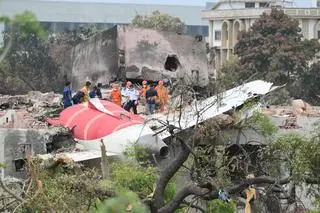
India’s aviation regulator has directed domestic airlines to conduct urgent inspections of fuel control switches on select Boeing aircraft models, following initial findings from the June 12 crash of an Air India Dreamliner, which claimed 260 lives.
In a directive issued Monday, the Directorate General of Civil Aviation (DGCA) ordered operators of Boeing 787s and 737s to examine the locking mechanism on fuel control switches, which came under scrutiny in the aftermath of the tragic crash near Ahmedabad.
The move follows a preliminary report released Saturday by the Aircraft Accident Investigation Bureau (AAIB), which revealed that the aircraft’s fuel switches had shifted from the ‘run’ to ‘cutoff’ position shortly after takeoff.
The report stopped short of assigning blame but noted a chilling exchange between the cockpit crew.
“One pilot asked the other why he had cut the fuel, to which the response was: ‘I didn’t’,” the AAIB report stated.
The crash involved a Boeing 787-8 Dreamliner bound for London, which went down minutes after departure, killing 241 of the 242 people on board, as well as 19 individuals on the ground—marking one of India’s deadliest aviation disasters in recent history.
While Boeing has reassured operators that the fuel switch locking mechanisms on its aircraft are safe, the Indian regulator’s order aligns with a Special Airworthiness Information Bulletin (SAIB) issued by the U.S. Federal Aviation Administration (FAA) last week.
The FAA bulletin recommended checks to ensure the switches could not be inadvertently moved during flight, prompting several airlines worldwide to preemptively begin inspections of their fleets.
“It has come to the notice of DGCA that several operators — both domestic and international — have initiated inspection on their aircraft fleet as per the SAIB,” the regulator said in a statement.
The DGCA has set a deadline of July 21 for all Indian carriers operating affected Boeing models to complete inspections and submit compliance reports.
In an internal memo to staff, Air India CEO Campbell Wilson acknowledged the gravity of the tragedy but cautioned against drawing early conclusions.
“The investigation is ongoing, and it would be unwise and premature to speculate or assign blame at this stage,” Wilson wrote.
The airline has pledged full cooperation with authorities and extended support to families of victims as recovery and identification efforts continue.
The crash and subsequent scrutiny come at a sensitive time for Boeing, which has faced multiple safety challenges over the past decade, including the global grounding of its 737 MAX fleet in 2019.
While there is no official indication of a systemic design flaw in this case, the renewed attention on cockpit components could trigger regulatory reviews beyond India and the United States.
As India’s aviation sector continues to grow at one of the world’s fastest rates, the tragic incident has also reignited public concern over aviation safety standards, pilot training, and equipment reliability.
Investigators are expected to release a final report in the coming months, which may determine whether the incident was due to mechanical failure, human error, or a combination of both.