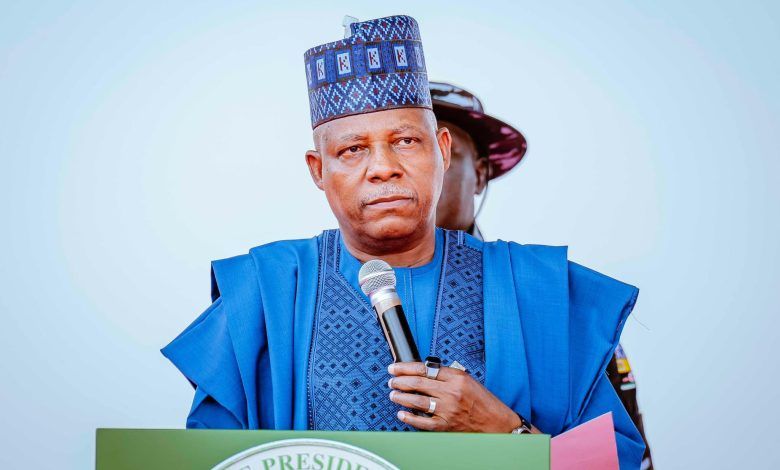
Vice President Kashim Shettima has reaffirmed the Federal Government’s commitment to transforming Nigeria’s agricultural sector, emphasizing the pivotal role of research institutions such as the International Institute of Tropical Agriculture (IITA).
Speaking during an assessment tour of IITA in Ibadan on Tuesday, Shettima expressed confidence in the institution’s expertise and its ability to harness Nigeria’s agricultural potential. He noted that President Bola Ahmed Tinubu’s administration is taking decisive action to address food security challenges by leveraging partnerships with research bodies and other stakeholders.
A Call to Action on Food Security
With Nigeria facing increasing concerns over food production and security, the Vice President stressed the urgency of turning policy commitments into tangible results.
“The IITA has been at the forefront of agricultural research, food security, and economic development across Africa for over five decades,” Shettima said. “We have some of the best crop scientists working here, but unfortunately, the Nigerian government has not fully utilized its potential. However, it’s better late than never.”
He further explained that the administration is taking proactive measures to partner with IITA and other institutions that offer practical research, innovative technology, and solutions tailored to local needs.
“Our visit, as directed by President Tinubu, is to see firsthand the advancements at IITA and provide a detailed report to him,” Shettima added.
IITA’s Role in Advancing Agriculture
The Director-General of IITA, Dr. Simeon Ehui, outlined the institute’s ongoing initiatives, particularly in providing farmers with access to climate-resilient seeds and advanced agricultural technologies.
“Our innovative systems, developed in collaboration with IITA-CGIAR and other partners, have significantly improved cassava, maize, and cowpea varieties, ensuring that farmers have access to high-yield and climate-resistant crops,” Dr. Ehui stated.
He highlighted IITA’s impact on small-scale and commercial farming, citing the USAID-funded Nigeria Integrated Agriculture Activity (NIAA) in the Northeast as an example. According to him, the initiative has successfully established community-based agricultural enterprises, boosting youth and women’s participation in farming.
“In addition to creating jobs, our work in the Northeast is increasing staple crop yields and ensuring Nigerians have access to nutritionally rich food,” he added.
Innovation in Fertilizer and Soil Health
Dr. Ehui also announced a significant milestone in the institute’s efforts—the launch of a Regional Hub for Fertilizer and Soil Health at IITA headquarters.
“This hub will drive sustainable fertilizer use, improve soil health, and directly support Nigeria’s push for increased agricultural productivity,” he explained.
Additionally, IITA has been instrumental in responding to agricultural crises, including its collaboration with the Presidential Food Systems Coordinating Unit (PFSCU) to combat the recent ginger blight epidemic.
Government Commitment to Agricultural Transformation
Vice President Shettima was accompanied on the tour by key government officials, including the Minister of Agriculture and Food Security, Sen. Abubakar Kyari, and the Senior Special Assistant to the President on Agribusinesses and Productivity Enhancement, Dr. Kingsley Uzoma.
During their visit, they inspected IITA’s Seed Multiplication Centre for yam and cassava, as well as the Business Incubation Platform (BIP), which is designed to support agricultural entrepreneurs.
With this renewed collaboration between the government and research institutions, Shettima reiterated that Nigeria is on the path to achieving long-term food security and a thriving agricultural sector.