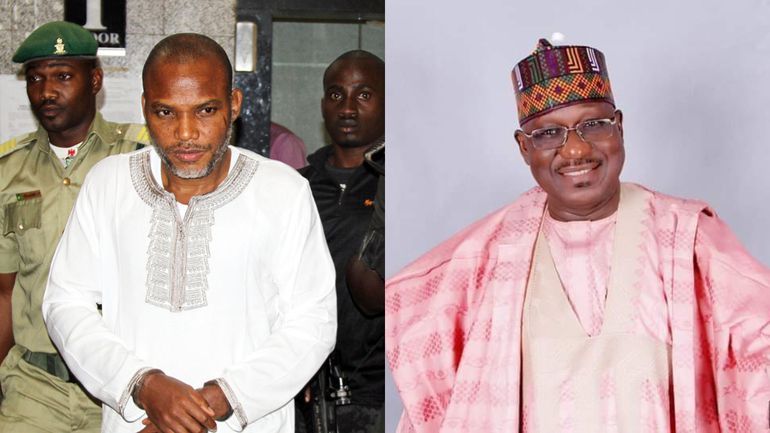
The Federal High Court in Abuja has admitted into evidence the death certificate and medical report of former presidential aide, Ahmed Gulak, in the ongoing terrorism trial of Nnamdi Kanu, the detained leader of the proscribed Indigenous People of Biafra (IPOB).
Justice James Omotoso, who presided over Tuesday’s proceedings, accepted the documents following no objection from the defence team, which includes Kanu Agabi (SAN), Chukwuma-Machukwu Ume (SAN), and Aloy Ejimakor. The documents were submitted by the prosecution, led by Adegboyega Awomolo (SAN), through a witness identified only as BBB.
The evidence also included a police report from Owerri, Imo State, linking Gulak’s 2021 assassination to gunmen suspected to be affiliated with IPOB.
During a tense cross-examination, lead defence counsel Agabi questioned the integrity of a video statement obtained from Kanu during his detention by the Department of State Services (DSS). He argued the footage was incomplete and lacked transparency, as it only showed Kanu and members of his legal team.
The prosecution witness maintained that the footage was complete, describing the process as standard procedure. However, when asked whether he wore a mask during the interrogation, the witness claimed he could not recall.
Agabi further raised concerns about Kanu’s prolonged detention and alleged solitary confinement, which he said constituted cruel and inhumane treatment. The witness distanced himself from responsibility, stating:
“Solitary confinement is not a practice of the DSS. I am not his handler. I was only involved in the investigation.”
Pressed on the legality of the charges, the witness acknowledged he had no involvement in drafting them and could not confirm when the various amendments were made.
A notable revelation during proceedings was the admission by the prosecution witness that, despite multiple amendments to the charge sheet over several years, Kanu had not been directly confronted with any accuser.
The witness stated he only presented a directive from the Attorney-General of the Federation (AGF) and played no role in facilitating direct confrontation or securing additional testimony.
This prompted Agabi to allege that the charges appeared speculative and politically motivated, particularly as investigations appeared to continue even after charges had been filed.
“You cannot build a case of this magnitude on assumptions and retroactive investigations,” Agabi argued.
The witness responded that he was merely acting on instructions passed to him through internal memoranda.
The defence further informed the court that critical police records requested had not yet been made available, undermining their ability to mount a full response. Although Awomolo objected to an adjournment—citing an existing court order for an accelerated hearing—Justice Omotoso allowed a short recess.
“This case has both national and international attention. Justice must be done, and be seen to be done,” the judge stated.
“I am inclined to grant this adjournment to ensure the defence has a fair opportunity. We must avoid delays that compromise justice.”
Before adjourning, the judge addressed a social media post by Ejimakor alleging that DSS officials had denied Kanu’s lawyers access to their client. While Agabi denied the claim in court, Justice Omotoso warned against unverified public commentary that could mislead the public or compromise court integrity.
“Counsel must exercise restraint in making public statements, especially on social media,” the judge cautioned. “Unprofessional conduct will not be tolerated.”
The matter was adjourned to May 21, 2025, at the instance of the defence. The case remains one of Nigeria’s most closely watched legal battles, with far-reaching implications for civil liberties, national unity, and due process.