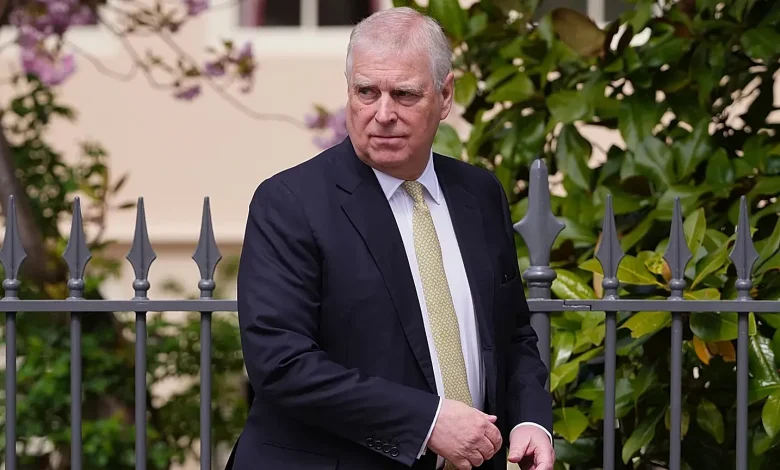
Britain’s former royal, Prince Andrew—now known as Andrew Mountbatten-Windsor—has been arrested on suspicion of misconduct in public office, in what observers describe as one of the most consequential legal developments involving a senior royal in modern British history.
The arrest comes as UK authorities intensify scrutiny over newly surfaced materials linked to convicted American sex offender Jeffrey Epstein.
The 66-year-old was detained by Thames Valley Police, which confirmed that “a man in his sixties from Norfolk” had been arrested on February 19 on suspicion of misconduct in public office. In keeping with standard UK procedure, police did not formally identify the individual.
British media reported that several unmarked vehicles, believed to be police cars, were seen arriving early Thursday at the Sandringham estate in eastern England, where Andrew currently resides.
Allegations Tied to Trade Envoy Role
The arrest follows recent disclosures suggesting that during his tenure as the United Kingdom’s trade envoy, Andrew may have shared potentially sensitive government-related information with Epstein.
An email dated November 2010, reportedly reviewed by AFP, appears to show Andrew forwarding reports on Vietnam, Hong Kong, Shenzhen, and Singapore after an official visit to Asia. He is also alleged to have subsequently shared details of the trip—including information on investment opportunities—at a time when Epstein’s business associates were reportedly involved.
Under official UK guidelines, trade envoys are bound by strict confidentiality obligations concerning commercially and politically sensitive information obtained during official assignments.
Andrew served as Britain’s trade envoy from 2001 for approximately a decade, a role aimed at promoting British commercial interests abroad.
A Deepening Royal Crisis
The arrest marks the latest and most dramatic chapter in Andrew’s prolonged fall from public grace. He was stripped of his military affiliations, patronages, and royal titles last year by his brother, King Charles III, and later vacated his former royal residence.
Andrew’s association with Epstein has for years cast a shadow over his public life. He has consistently denied any wrongdoing in relation to the disgraced financier. However, one of Epstein’s victims previously alleged she had been trafficked to have sex with him—an accusation Andrew has firmly rejected.
In a rare and carefully worded statement last week, Buckingham Palace indicated it was “ready to support” law enforcement authorities in their inquiries, underscoring the gravity of the unfolding investigation.
Expanding Investigations Across the UK
The inquiry has broadened significantly. At least nine UK police forces have confirmed they are assessing information that appears to reference Andrew in connection with Epstein.
Surrey Police said it had become aware of a redacted report alleging “human trafficking and sexual assaults on a minor” between 1994 and 1996 in Virginia Water, a village in southeastern England.
The report forms part of a new tranche of documents released by the US Department of Justice relating to Epstein, who died in prison in 2019 while awaiting trial.
The disclosures have renewed calls for deeper scrutiny of historic travel records linked to the financier. Former UK prime minister Gordon Brown urged police to re-examine decades-old flights arriving at British airports allegedly tied to Epstein.
Writing in the New Statesman, Brown said he had been privately informed that earlier investigations may not have fully examined key flight evidence.
“I have asked the police to look at this as part of the new inquiry,” Brown wrote, suggesting that critical information may previously have been overlooked.
Meanwhile, the Metropolitan Police has launched a separate investigation into the relationship between Britain’s former ambassador to Washington, Peter Mandelson, and Epstein.