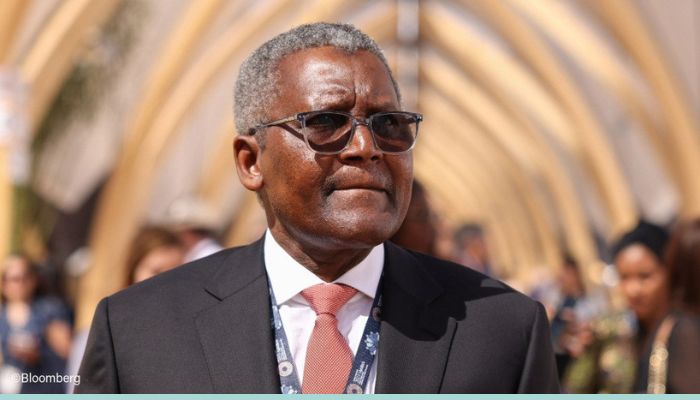
In a bold move signaling Nigeria’s growing footprint in global refined fuel markets, the Dangote Petroleum Refinery has exported approximately 1.35 billion litres of Premium Motor Spirit (PMS) within the last 50 days.
This was revealed by Aliko Dangote, President of the Dangote Group, at the Global Commodity Insights Conference on West African Refined Fuel Markets. The event, currently underway in Abuja, is hosted by the Nigerian Midstream and Downstream Petroleum Regulatory Authority (NMDPRA) in collaboration with S&P Global Insights.
Dangote told industry stakeholders that between June and mid-July 2025, the refinery had shipped about 1 million metric tonnes of petrol to international buyers a volume equivalent to roughly 1.35 billion litres.
“Before I got on stage, I asked my team how much PMS we’ve exported. From the beginning of June until now, it’s about 1 million tonnes just over 50 days. Nigeria has, for the first time, become a net exporter of refined petroleum products,” Dangote said.
Nigeria Still Heavily Dependent on Fuel Imports
Despite the massive export volumes, Nigeria continues to rely significantly on imported petrol to meet domestic demand. According to the NMDPRA, nearly 69% of all gasoline consumed in Nigeria and across West Africa still originates from foreign suppliers.
NMDPRA Chief Executive, Farouk Ahmed, shared that the region sees an average monthly gasoline trade of 2.05 million metric tonnes, with the vast majority still imported.
In just the past eight days, Nigeria brought in over 231 million litres of PMS, based on shipping data obtained by The PUNCH. The Nigerian Ports Authority’s Shipping Position Daily shows that 172,917 metric tonnes of petrol were delivered to terminals at Apapa, Tincan, and Calabar ports equivalent to 231.88 million litres.
Dangote Responds to Monopoly Claims
While the Dangote refinery’s export drive has been widely praised, it has also drawn criticism from some quarters, including accusations that the facility is positioning itself to dominate Nigeria’s downstream sector.
Dangote dismissed the allegations, pointing out that rather than investing in Nigeria’s industrial development, many critics choose to invest their capital abroad while offering little constructive support.
“Let me use this platform to address the monopoly concerns. Too many people who can help move our country forward choose instead to sit on the sidelines, invest abroad, and criticise those trying to build,” he said.
Tinubu Calls for Energy Sovereignty
President Bola Tinubu also weighed in during the conference, stating that Africa must evolve from being a passive price taker in the global energy economy to a continent that shapes its own pricing mechanisms and trade structures.
“Africa can no longer remain a price taker for its resources,” Tinubu wrote in a message posted to his official X (formerly Twitter) account. “We must establish credible, transparent benchmarks that reflect our production realities and protect our economies.”
The president noted that Nigeria is working alongside regional partners to create an integrated energy market that not only prioritizes local access but also fosters cross-border prosperity.
“From refining to regulation, data transparency to trade flows, Nigeria is collaborating with its neighbors to build an integrated market that rewards our production, secures energy access for our people, and strengthens prosperity across borders,” he said.
Plans for Regional Price Benchmark
To help facilitate this integration, the NMDPRA is partnering with S&P Global Commodity Insights to develop new pricing benchmarks for refined petroleum products in West Africa. These indices will cover PMS, Automotive Gasoil, Aviation Turbine Kerosene, and Liquefied Petroleum Gas.
The goal, according to Farouk Ahmed, is to create a transparent, data-driven pricing model that encourages investor confidence and enhances supply chain efficiency across the region.
“We are committed to building a transparent market environment with real-time pricing that reflects the true cost and value of fuel within West Africa,” Ahmed stated.
The establishment of a regional benchmark could mark a major shift in how fuel prices are determined in the region potentially reducing dependence on global reference prices and strengthening West Africa’s energy autonomy.