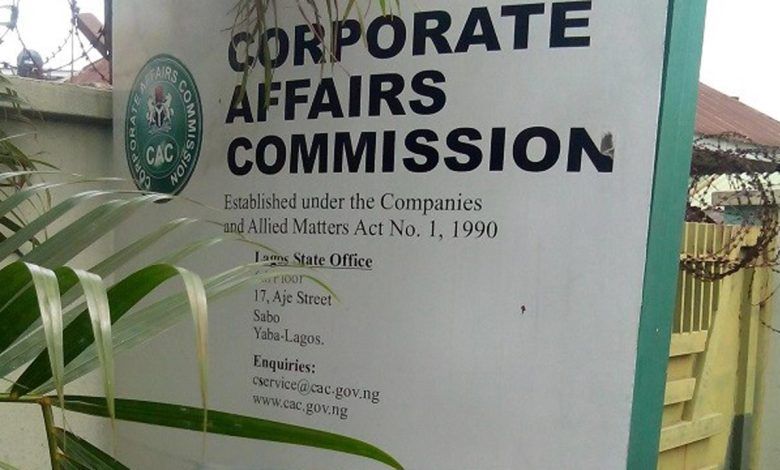
Registrar-General calls for unified beneficial ownership register, warns inactive firms must not be allowed to transact….
The Registrar-General of the Corporate Affairs Commission (CAC), Hussaini Magaji, has accused some banks and financial institutions of weakening Nigeria’s anti-corruption and corporate compliance framework by allowing inactive and non-compliant companies to continue operating and carrying out financial transactions.
Magaji also revealed that the Commission has reported 248 fake company registrations to the Economic and Financial Crimes Commission (EFCC) for investigation and prosecution. In addition, three members of staff of the CAC were handed over to the Independent Corrupt Practices and Other Related Offences Commission (ICPC) over alleged internal misconduct.
He made the disclosures on Tuesday in Abuja during an Anti-Corruption Day presentation and panel discussion organised as part of activities marking the Commission’s 35th anniversary. Magaji spoke on the theme, Transparency for Development: The Nigeria Experience, before representatives of key anti-corruption and law enforcement agencies.
The CAC boss warned that Nigeria’s corporate regulatory system would remain exposed to abuse unless compliance rules are enforced consistently across all institutions.
He stated that companies that fail to disclose their Persons with Significant Control (PSC) are flagged as inactive by the Commission and should not be permitted to engage in credible transactions.
“Let me state clearly: at CAC today, no company without full disclosure of its Persons with Significant Control is recognised as compliant. Companies that fail to disclose their PSC are flagged as inactive, and such status renders them unfit for credible transactions,” he said.
Magaji expressed concern that some financial institutions continue to ignore this classification, allowing inactive companies to operate, open bank accounts, and transact freely.
“While CAC may flag such companies as inactive, some financial institutions, particularly banks, still allow them to operate and transact. This is a major weakness in our national compliance chain, and we must work together to address it,” he said.
He stressed that Nigeria’s regulatory ecosystem must operate in alignment, insisting that non-compliant companies should not enjoy the privileges of legality.
To strengthen compliance and internal integrity, Magaji disclosed that the Commission had taken disciplinary action against three staff members who were handed over to the ICPC over alleged unauthorised tampering with company records.
He also revealed that 248 fake company registrations were discovered to have been illegally inserted into the CAC system and subsequently reported to the EFCC. An additional 15 suspicious entities were also submitted for further investigation.
According to him, the identified entities operated without traceable corporate identities and failed to contribute to national revenue through taxation. He added that no legitimate legal challenge has been filed against the Commission regarding the removal and reporting of the fraudulent registrations.
Magaji renewed his call for the creation of a single, harmonised national register for beneficial ownership information, warning that the current fragmented system creates loopholes that could be exploited for corruption, money laundering, and illicit financial flows.
He explained that although Nigeria has made progress in beneficial ownership transparency, multiple sector-specific registers — including those in the extractive industry and the Nigeria Export Processing Zones Authority — operate outside the central CAC database, leading to duplication and regulatory gaps.
“At the moment, we operate a fragmented system where certain sectors maintain separate beneficial ownership registers outside the central register managed by CAC. This creates inconsistencies, weakens our national integrity framework, and complicates law enforcement,” he said.
Magaji noted that the CAC is legally positioned to serve as the central repository for beneficial ownership information and urged stakeholders to support reforms toward establishing a unified national register.
He said such a system would strengthen verification, improve transparency, and enhance Nigeria’s compliance with global anti-money laundering and counter-terrorism financing standards.
The Registrar-General also described beneficial ownership disclosure as a growing global priority, citing recent international developments, including court rulings in the United Kingdom involving property ownership linked to Nigerians.
He called for the elevation of the Persons with Significant Control Rules into an Act of the National Assembly to provide a stronger legal foundation for enforcement.
Magaji further expressed concern over the practice by some large corporations of listing other companies, rather than individuals, as beneficial owners, noting that such arrangements undermine transparency and accountability.
He concluded by urging stronger collaboration among Nigeria’s anti-corruption and law enforcement agencies, including the EFCC, ICPC, Nigeria Financial Intelligence Unit, and the National Drug Law Enforcement Agency.
According to him, the fight against corruption requires sustained coordination, trust, and institutional cooperation.
“Our collaboration must not be episodic. It must be structured, sustained, and institutionalised so that our collective efforts deliver measurable outcomes for Nigeria,” he said.
The panel discussion formed part of activities commemorating the Corporate Affairs Commission’s 35th anniversary.