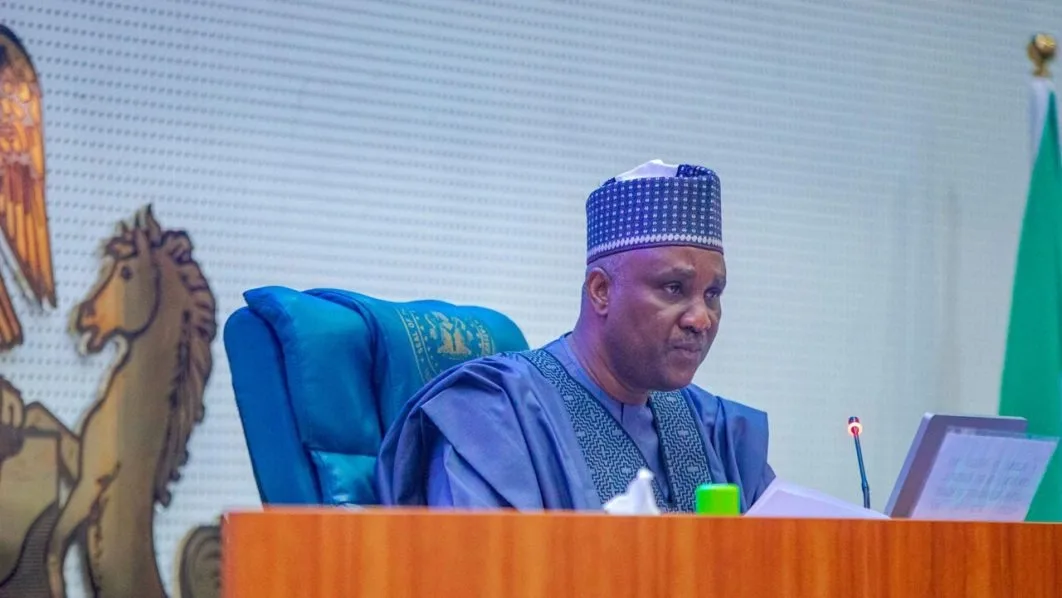
The legal battle over the suspension of Senator Natasha Akpoti-Uduaghan of Kogi Central has escalated, with Senate President Godswill Akpabio approaching the Supreme Court to challenge lower court decisions on the matter.
Court documents obtained on Thursday show that Akpabio filed an application before the apex court to regularise and sustain his appeal. The documents are filed under SC NO: SC/CV/1111/2025; Appeal No: CA/ABJ/CV/1107/2025; and Suit No: FHC/ABJ/CS/384/2025.
The motion partly reads: “Motion on Notice brought pursuant to Order 4 Rules 6 & 16 of the Supreme Court 2024, Sections 22, 27(1)4, 2 & 4 and 29 of the Supreme Court Act CAP S.15 Laws of the Federation, Section 233(1) and 3 of the Constitution of the Federal Republic of Nigeria 1999 (as amended), and under the inherent jurisdiction of this Honourable Court.”
Akpabio is listed as the appellant, while the respondents include Akpoti-Uduaghan, the Clerk of the National Assembly, the Senate of the Federal Republic of Nigeria, and Senator Neda Imasuen, Chairman of the Senate Committee on Ethics, Privileges, and Public Petitions.
The dispute stems from a February 2025 Senate plenary session during which Akpoti-Uduaghan raised issues of privilege and alleged procedural breaches. The matter was referred to the Senate Committee on Ethics, Privileges and Public Petitions, which recommended her suspension.
Dissatisfied with the action, Akpoti-Uduaghan approached the Federal High Court, Abuja, claiming her right to a fair hearing had been violated and that the Senate had failed to comply with its Standing Orders. On July 4, 2025, the court ruled the suspension excessive and unconstitutional.
After proceedings at the Court of Appeal, Akpabio has now taken the case to the Supreme Court, seeking: an extension of time to apply for leave to appeal, leave to appeal on grounds of mixed law and fact, and an order deeming his notice of appeal and brief of argument as properly filed.
Akpabio argues that the Senate acted within its powers under Section 60 of the 1999 Constitution, which empowers the National Assembly to regulate its internal procedures.
He further contends that the Senate President was not obligated to immediately rule on every point of privilege and that the disciplinary process was lawfully activated.
Akpoti-Uduaghan, however, maintains that her suspension was unlawful and carried out without a fair hearing, insisting that the Senate failed to follow its own rules.
Her lawyers have reportedly been served with the Supreme Court processes. The case also involves a related contempt issue arising from a social media post by Akpoti-Uduaghan during the pendency of the suit. The Federal High Court had fined her and ordered a public apology, a decision she has also appealed.
Legal analysts say the Supreme Court’s ruling could provide clarity on the limits of legislative discipline and the scope of judicial intervention in internal parliamentary matters.
The development comes barely two weeks after Akpabio announced his decision to withdraw pending court cases against his political adversaries.
Akpoti-Uduaghan resumed her Senate duties on September 23, 2025, after completing a six-month suspension and regaining access to her office at the National Assembly.
Her office had been sealed since March 6, 2025, following her suspension over alleged misconduct during a protest against the reassignment of her seat by Akpabio on February 20.
Despite the lapse of her suspension, her return was delayed due to ongoing legal battles and resistance from the Senate leadership.
Following the July 4 judgment, she formally notified the Senate of her intention to resume, a request that was initially rejected.