Labour says rising transport, food, rent and education costs have weakened workers’ purchasing power and calls for urgent government intervention…..
The Nigeria Labour Congress has renewed pressure on the Federal Government to ease the cost-of-living crisis, demanding a reduction in petrol prices, a nationwide wage award and the immediate commencement of talks on a new national minimum wage.
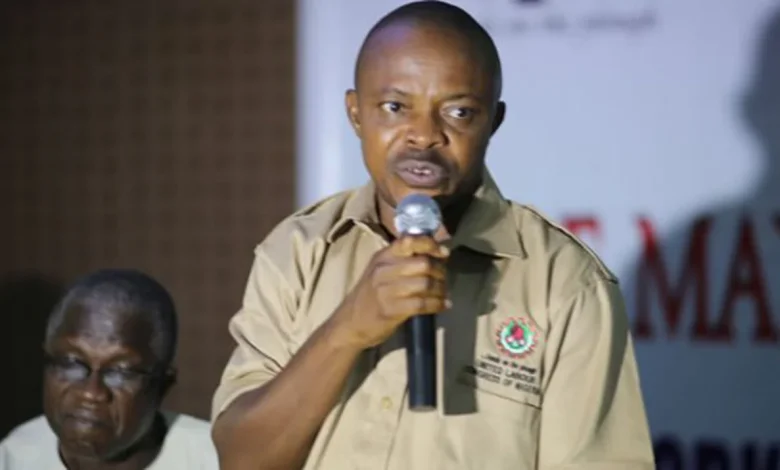
The demands were contained in an Independence Day statement signed by NLC President, Joe Ajaero, and titled, “Our Hope Depends on the Choices We Make and the Actions We Take.”
The labour centre said the rising cost of basic necessities had continued to erode the purchasing power of workers and other Nigerians, with transportation, food, rent and education becoming increasingly difficult for households to afford.
The NLC particularly blamed the increase in petrol prices following the removal of the subsidy in 2023 for intensifying the pressure on household incomes.
“Petrol now sells at N1,430 per litre or higher in major cities and far more in remote areas. The surge in transportation costs drives up the prices of food, school fees, rent, and nearly every necessity of life, while nominal wages remain stagnant,” the union said.
According to the NLC, reducing the impact of fuel prices on transport and other sectors of the economy must be treated as an urgent priority.
“Without cutting this chain, any effort to ease the suffering of the people is futile,” it said.
Beyond petrol prices, the union called for an immediate wage award for workers across the federal, state and local governments, describing the intervention as necessary to cushion the decline in real incomes.
“A wage award is not charity. It is an emergency intervention against the collapse of real income,” the NLC said.
The demand comes against the backdrop of an October 2023 agreement between the Federal Government and organised labour following the removal of the petrol subsidy. The agreement included a N35,000 monthly wage award for federal workers, with similar relief proposed for workers at the state and local government levels.
The labour centre also accused the government of failing to fully implement tax relief measures contained in the October 2023 Memorandum of Understanding reached with organised labour.
It called for the outstanding tax relief measures to be implemented and urged the government to begin negotiations for a new national minimum wage.
“The current N70,000 minimum wage was already destroyed by inflation before it was implemented,” the union said.
It consequently called for the immediate establishment of a tripartite committee to develop and legislate a new wage standard for 2027 before the end of the year.
The N70,000 national minimum wage was approved by President Bola Tinubu in July 2024, with the Federal Government indicating that it would be reviewed after three years.
The NLC also questioned the use of savings from the petrol subsidy removal, arguing that Nigerians had yet to see sufficient improvements in infrastructure and social services.
“Government claimed subsidy removal would free up resources for infrastructure and social services. Three years later, petrol prices have multiplied several times over, yet the promised infrastructure and social services remain mirages. Where exactly did the subsidy savings go?” the union asked.
The Federal Government and organised labour had agreed in October 2023 to a number of measures intended to cushion the effects of subsidy removal, including wage support, tax incentives and the deployment of compressed natural gas buses.
The NLC further raised concerns over Nigeria’s dependence on imported refined petroleum products despite being a major crude oil producer.
It called for greater investment in domestic refining, saying the country should reduce its reliance on imported petroleum products while strengthening local refining capacity.
“Nigeria, Africa’s largest oil producer, depends on imported refined petroleum, while domestic refining capacity has been systematically neglected, except the efforts of a few private refineries,” the union said.
On the wider economy, the NLC called for a reduction in the cost of governance and greater transparency in public spending, alongside increased investment in roads, hospitals, schools and other public infrastructure.
“When workers are asked to tighten their belts, the extravagance and waste of the governing class are unacceptable. Government must lead by example,” it said.
The union also demanded improvements in public education and healthcare, arguing that affordable and functional social services would help reduce the financial burden on households.
It linked youth unemployment and migration to the lack of economic opportunities, urging the government to create conditions that would give young Nigerians stronger incentives to build their futures in the country.
“The government must create genuine opportunities so that young people can see hope instead of being preached to about hope,” the NLC said.
The labour centre also expressed concern over the impact of insecurity on farming, education and healthcare, arguing that poverty, unemployment, inequality and insecurity were interconnected challenges requiring coordinated action.
On the 2027 general elections, the NLC said workers must be allowed to exercise their political rights independently and called against voter intimidation, electoral manipulation and rhetoric capable of deepening ethnic and religious divisions.
Ajaero said the NLC would, at the appropriate time, present its positions on policies and candidates through its proposed Workers’ Charter, while insisting that labour organisations should not be reduced to electoral instruments.
“The Nigeria Labour Congress will, at the appropriate time, use our Workers’ Charter to make it clear which policies and candidates deserve the support of the working class,” Ajaero said.
“However, we will never accept any force treating workers’ organisations as dispensable electoral tools. Workers have the right to independent political thoughts, judgement, and choice.”
The NLC said it would continue to focus on issues affecting workers, including decent wages, workplace safety, accountability and improved living conditions.