Alausa Sets 70% Benchmark for Textbooks, Says Substandard Books Won’t Be Allowed in Schools

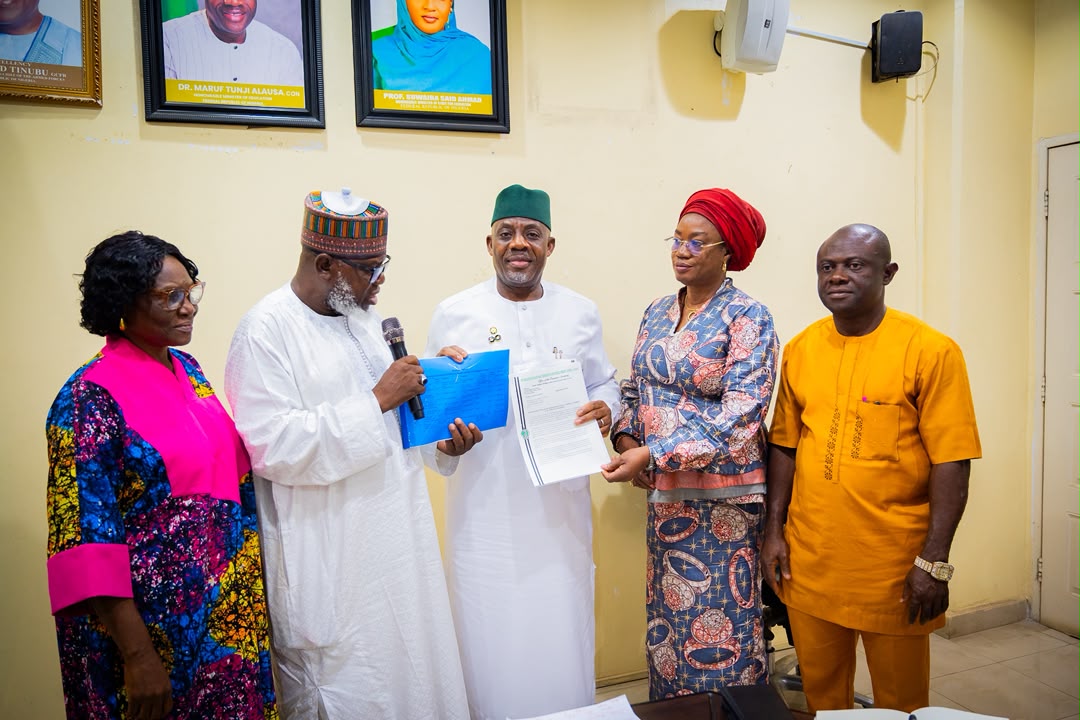
The Minister of Education, Dr. Maruf Tunji Alausa, has set a minimum benchmark of 70 per cent for textbooks to qualify for ranking, warning that substandard instructional materials will no longer be allowed to undermine the quality of education in Nigeria.
A Statement by Ikharo Attah, Special Adviser on Media and Communications indicates that Alausa stated this in Abuja while receiving the report and ranked list from the country’s first national textbook assessment and ranking exercise.
He said the exercise was part of the Federal Government’s broader quality assurance drive following the introduction of the revised national curriculum in September 2025.
According to him, the Nigerian Educational Research and Development Council (NERDC) developed a standardised assessment toolkit, benchmarked against international best practices, to ensure that textbooks align with the revised curriculum and meet acceptable quality standards.
The Minister disclosed that curriculum alignment accounted for 51 per cent of the assessment, while other criteria included language and style, instructional design, technical features, social and cultural compliance, and gender sensitivity.
He explained that the 70 per cent threshold was deliberately established to ensure that only textbooks meeting an acceptable quality level would qualify for ranking.
Alausa, however, said publishers whose books fell below the benchmark would be given the opportunity to identify deficiencies, make corrections and resubmit their materials.
The assessment, he disclosed, revealed significant disparities in the quality of submitted textbooks, with some scoring as low as 25 per cent.
Reacting to the findings, the Minister described some of the books currently being used in Nigerian schools as unacceptable.
“Some of the books being used in our schools, primary schools, junior secondary schools and senior secondary schools are trash. Some of these books are scoring 25 per cent or lower. Is this the way our children should be educated? If this happened with the government, it will not happen with this government,” he said.
The Minister urged the Nigerian Publishers Association and affected publishers to study the assessment results, correct identified deficiencies and align their materials with the revised curriculum before resubmission.
“I’m giving you the olive branch,” Alausa said, while commending publishers who participated in the exercise despite what he described as pressure and blackmail.
He disclosed that the national textbook assessment would be conducted in three cycles to cover all levels of the basic and senior secondary school curriculum.
The first cycle covers Primary 1 and 4, JSS 1 and SS 1; the second will cover Primary 2 and 5, JSS 2 and SS 2, while the third will cover Primary 3 and 6, JSS 3 and SS 3.
Alausa also announced that the national curriculum would henceforth be reviewed every three years to ensure that it remains responsive to emerging educational, technological and societal needs.
Providing further details on the assessment, the Executive Secretary of NERDC, Prof. Salisu Shehu, said the exercise was conducted in line with the Council’s statutory mandate to develop, review and promote quality educational materials.
Shehu said the process involved subject specialists, education experts and NERDC personnel working with approved criteria and a scoring framework.
He added that peer review was incorporated into the process, stressing that the outcome was not based on the judgment of a single officer but on documented professional assessments and collective expert judgment.
The NERDC boss said the 70 per cent threshold represented the minimum standard for ranking, while the discovery of scores as low as 25 per cent demonstrated the need for a transparent and evidence-based mechanism for determining the quality of instructional materials.
Alausa said the exercise was not merely about ranking textbooks but about protecting the quality of learning in Nigerian schools.
He stressed that every instructional material presented to Nigerian learners must be accurate, curriculum-aligned and fit for purpose, assuring that the Federal Government would continue to support publishers willing to meet the required standards.
He added that publishers already meeting the benchmark would be expected to sustain and continually improve their standards, in line with the Federal Government’s commitment to raising the quality of education under President Bola Ahmed Tinubu’s Renewed Hope Agenda.